How Plumbing Companies Get Commercial Plumbing Contracts
· 8 min read
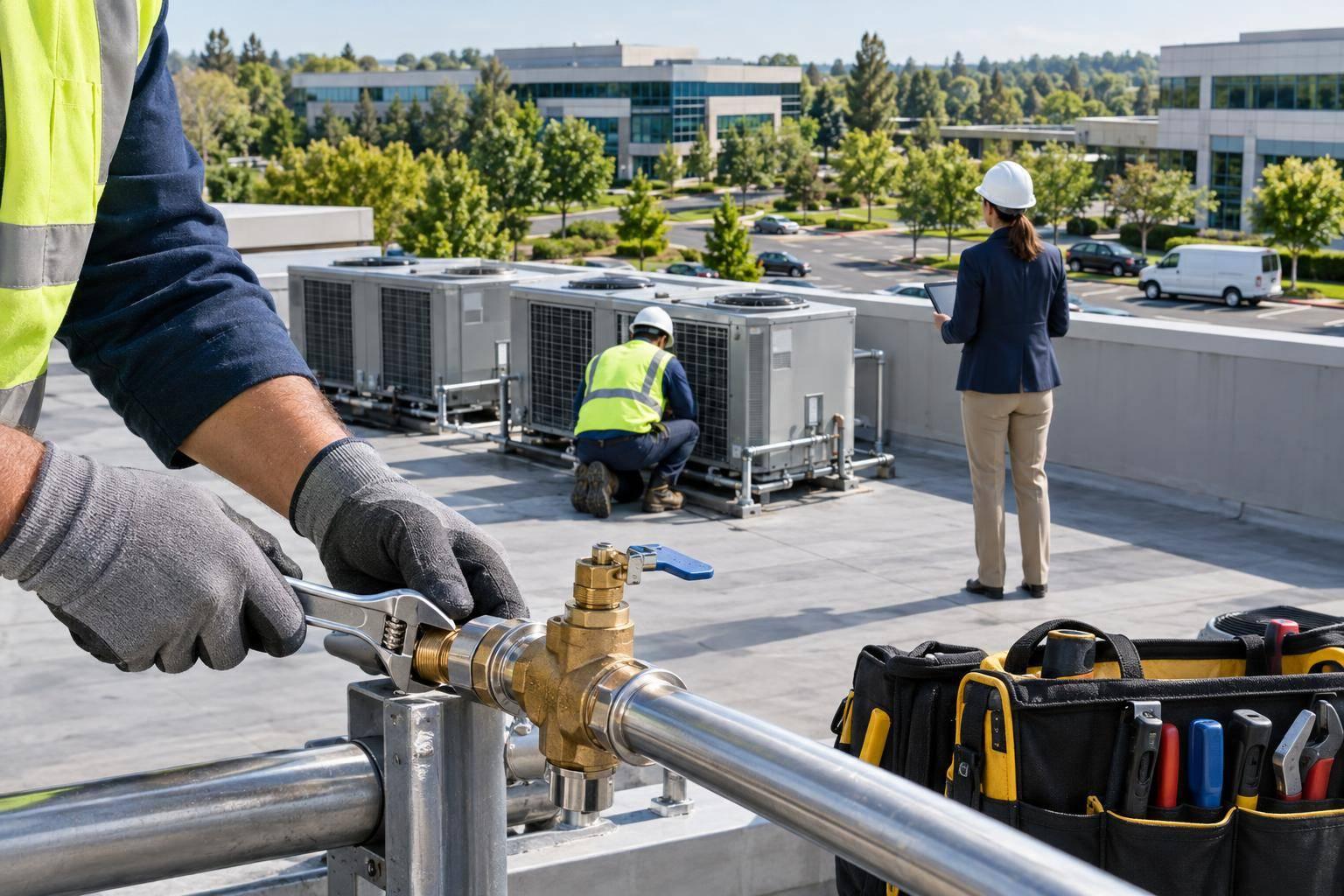
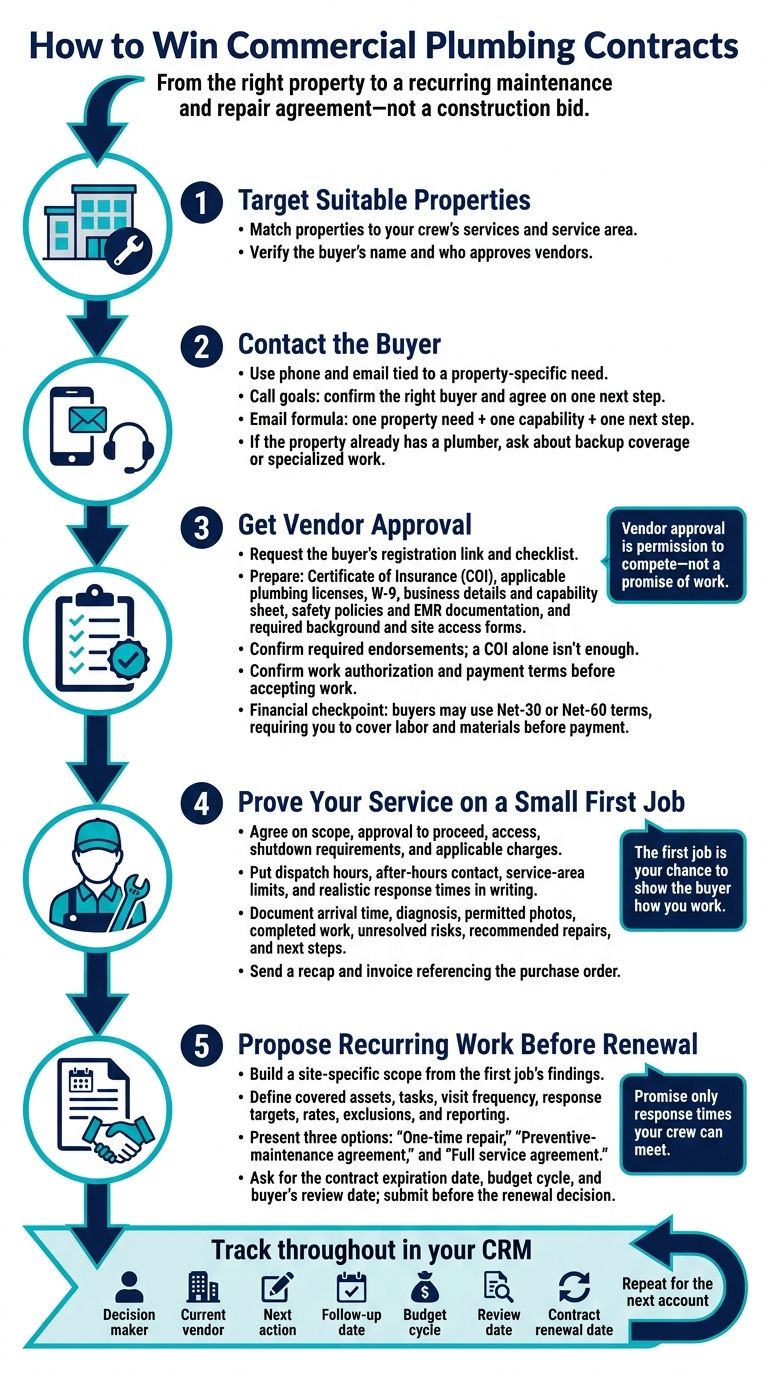
To win commercial plumbing contracts, start with properties your crew can serve, confirm who approves vendors, and offer a small first job. The goal is a recurring maintenance and repair agreement - not a construction bid.
Here’s the process:
- Find the right buyers. Match properties to your services, verify names, and contact buyers by phone and email.
- Get approved. Submit the required licenses, insurance, tax forms, and safety records. Check payment terms before accepting work.
- Prove your service. Complete a limited job, document the results, and set response times your crew can meet.
- Propose recurring work. Define maintenance tasks, repair coverage, rates, and reporting. Offer repair-only, maintenance, and full-service options.
- Track the next decision. Record contacts, follow-ups, budget dates, and contract renewals in your CRM.
Treat vendor approval as permission to compete, not a promise of work. The first job is your chance to show the buyer how you work.
Contact Plumbing Buyers by Phone and Email
Confirm the Buyer and Ask for a Next Step
Give each call two goals: confirm the right buyer and agree on one next step. Start with a property-specific trigger, such as a backflow deadline found in public records. Then ask who approves plumbing vendors, where approval happens, and whether they want registration instructions, a service packet, or a site walk. Check that the contact you found actually makes those decisions.
If a gatekeeper answers, record the referral and confirm the next person’s role. Many calls will reach a gatekeeper or end with a quick no. If the property already has a plumber, ask whether they need backup coverage or specialized work.
Record the current vendor, why the buyer plans to keep them, and a follow-up date. Let that answer guide your next call: to the buyer, a manager, or procurement.
Send Relevant Emails and Schedule Follow-Ups
Build each email around one property need, one capability, and one next step. Open with a property-specific trigger, such as a health department deadline. Name your company and service area, explain the service you can deliver, and ask permission to send your service packet.
Use your license number or other accurate credentials instead of unsupported claims. Don’t promise emergency response times your dispatch team can’t support.
After the first call, send an email tied to the property’s need. Follow up with useful service details, then reconnect before the buyer’s stated vendor review date. Adjust your timing and message based on their response.
Clearly identify your business, include required sender details and an easy opt-out, and honor opt-outs across every record. Once someone responds, move straight to vendor approval and the first job.
Data Note: Email Replies and Calling Results
Use these results to plan a call-and-email sequence - not outreach that stops after one attempt.
This article is published by The Headline Theory, which runs cold email and cold calling for commercial service companies, contacting property managers, facility directors, maintenance directors, and building engineers. Across its email campaigns, emails sent to the named decision maker drew about twice as many interested replies per contact as emails sent to a general contact. The median time from the first email to the first booked meeting was 3 days.
During the first four weeks of its October–November 2026 landscaping and HVAC calling program, callers reached a live person on about 27% of 1,086 dials. Apartment and condo communities answered and talked on 33% of dials, compared with 19% for other commercial property types. Across 296 live conversations, about 4 in 10 reached a gatekeeper rather than the decision maker.
These results come from landscaping and HVAC calls, not plumbing calls, and they don’t guarantee outcomes. Use them to account for unanswered calls and gatekeepers in your outreach plan.
Get Vendor Approval and Win the First Job
Prepare Your Vendor Packet and Register
Ask the buyer, property manager, facility director, or procurement contact for the registration link and checklist. Register directly with the property manager or through a vendor portal like ISNetworld or Avetta. Confirm who issues purchase orders, work orders, and emergency work orders - and what approval you need before dispatching. Vendor approval puts you on the bid list. It doesn’t guarantee work.
| Document checklist | Buyer purpose | Update trigger |
|---|---|---|
| ☐ Certificate of Insurance (COI) | Verify required liability and workers’ compensation coverage; add the owner or manager as additional insured when required | Policy renewal or expiration |
| ☐ Applicable plumbing licenses | Confirm authority to perform the work | License expiration |
| ☐ W-9 | Set up tax reporting and payment | Change in business entity or address |
| ☐ Business details and capability sheet | Confirm contacts, service area, relevant projects, and references | Contact or business changes |
| ☐ Safety policies and EMR documentation | Review safety practices and risk | Annual review, EMR update, or safety incident |
| ☐ Required background and site access forms | Meet facility security requirements | Personnel change or facility protocol change |
Build your packet around the buyer’s checklist, not a generic template. Ask your insurance agent to add any required endorsements; a COI alone isn’t enough. Check payment terms before accepting work, too. Commercial buyers often pay on net terms (such as Net-30 or Net-60), so you may need to cover labor and materials for several weeks before you get paid.
Set Emergency Response Terms and Offer a First Job
Once you’re approved, aim for a small first assignment you can finish promptly and document clearly. It’s a chance to show that you can respond, keep clear records, and turn a service call into a longer-term agreement.
Put your dispatch hours, after-hours contact, service-area limits, and realistic response times in writing. Explain what happens if you can’t accept a dispatch. Before sending a technician, confirm the problem, site access, spending authority, shutdown approval, and after-hours charges.
Offer a limited first job that fits the property’s needs: an emergency repair, backflow testing, a compliance inspection, drain or grease-trap service, or a water-heater evaluation. Check the applicable deadline rather than assuming every property follows the same testing schedule. Agree on the scope, approval to proceed, and any off-hours or shutdown costs before work begins.
Document Your Work and Propose a Maintenance Schedule
Record your arrival time, diagnosis, permitted photos, completed work, unresolved risks, recommended repairs, and next steps. Send the recap with an invoice that references the purchase order. Then use your findings to propose an inspection, maintenance, and repair schedule for that site. Base visit frequency on equipment condition, occupancy, operating hours, tenant use, and failure history.
Use the first job’s work order, photos, and findings to set the scope, response times, rates, and reporting in your renewal proposal.
Submit Your Proposal Before the Renewal Decision
Use the first job to turn a property manager or facility director into a recurring account.
Specify Scope, Response Times, Rates, and Reports
Build your proposal from the first job’s photos, notes, and repair history. Use those findings to write a site-specific scope that names the covered assets, locations, tasks, and visit frequency. Spell out access limits, shutdown responsibilities, exclusions, and a concealed-conditions clause. Price optional work separately so procurement can compare bids.
Set clear response targets, and distinguish urgent calls from planned shutdown work. List labor rates, parts pricing, overtime rules, and payment terms. Specify the reports and records you’ll provide: work orders, invoices, asset history logs, and digital photos taken during service.
Compare Repair and Service Agreement Options
With the scope set, give the buyer three pricing options: a one-time repair, preventive maintenance, or a full service agreement.
| Option | Scope | Response commitment | Reporting | Pricing |
|---|---|---|---|---|
| One-time repair | Emergency fix; parts and labor itemized | Best effort; no continuing priority unless specified | Invoice and recap | Per-job quote; due on completion or net terms |
| Preventive-maintenance agreement | Scheduled inspections, jetting, and backflow tests | Priority over non-contract calls | Asset logs and checklists | Annual or quarterly fee |
| Full service agreement | Preventive maintenance plus covered repair labor and parts | Guaranteed response under the agreed SLA | Monthly or quarterly summaries | Recurring fee; exclusions billed separately |
State exactly which repair labor and parts the price covers and which cost extra. Broad coverage does not mean unlimited coverage.
Plan Around Contract and Budget Deadlines
Before the current agreement expires, ask for its expiration date and the buyer’s budget cycle. Work backward from those dates so your proposal arrives before the renewal decision.
Set reminders for the renewal date, budget cycle, and decision maker’s review date.
Conclusion: Repeat the Process to Win More Contracts
Once you send your proposal, use the same workflow for the next account: target the right properties, contact the buyer by name, get approved, win the first job, and send a renewal proposal before the current agreement ends.
Track each account in your CRM by decision maker, renewal date, and next action. That way, you’ll know who to contact before they make a renewal decision. Earn that renewal by promising only response times your crew can meet, sending clear service reports, and following through on every recommendation.
For outbound prospecting done for you, see commercial plumbing lead generation. To compare your options for booking meetings, read who can book meetings with commercial property managers.
FAQs
Which commercial properties should you target first?
Focus on properties within your service area that your team has the capacity to support. Property management firms are a good place to start: they oversee multiple buildings and often make vendor decisions centrally.
Target multifamily properties and apartment communities for recurring repairs, retail, healthcare, and hospitality properties for preventive maintenance, and office portfolios for expansion opportunities.
Before you reach out, confirm that you can meet each property’s documentation and emergency response requirements.
How can you price contracts without underestimating repair costs?
Build your estimates around current labor and material costs. Price urgent repair calls separately from planned maintenance to account for the different demands and risks of each.
Your proposal should clearly spell out the scope, response times, exclusions, price adjustments, renewal terms, schedule, and payment terms. Keep enough active opportunities in your pipeline so you can stay selective - and turn down work that doesn’t fit your capabilities or cost structure.
How can you win work from an incumbent plumber?
Show that you’re more reliable and easier to work with, not just cheaper. Find out where emergency response has fallen short of expectations. Then offer a backflow test or inspection instead of asking the property to switch contracts right away.
Use that first job to show your professionalism and provide clear documentation. Follow up with a simple proposal tailored to the property’s needs, covering preventive maintenance, response times, service scope, and reporting.
Related posts
One company per service area. See if yours is still open.