How to Get Commercial Snow Plowing Contracts
· 7 min read
How to Get Commercial Snow Plowing Contracts
To get commercial snow plowing contracts, start with the person who approves the work - not the estimate. First, confirm the buyer, bid deadline, and vendor requirements. Late in the season, focus on late bids and backup-vendor slots if the main contract is already signed.
Here’s the approach:
- Pick sites that fit your route and crew capacity.
- Walk the property before setting the scope, snow-depth trigger, response window, and price.
- Prepare the paperwork: insurance, vendor forms, references, and clear per-push or seasonal terms.
- Email the named buyer with a site-specific message and one clear request.
- Track the deal through signing, then discuss landscaping under a year-round agreement.
The Headline Theory reports 17 commercial meetings from its snow-removal campaigns, with about 70% of interested replies coming from the first email. Those are campaign observations, not promised results.
The rule: <u>confirm the signed agreement before committing crews or equipment.</u>
::: @figure 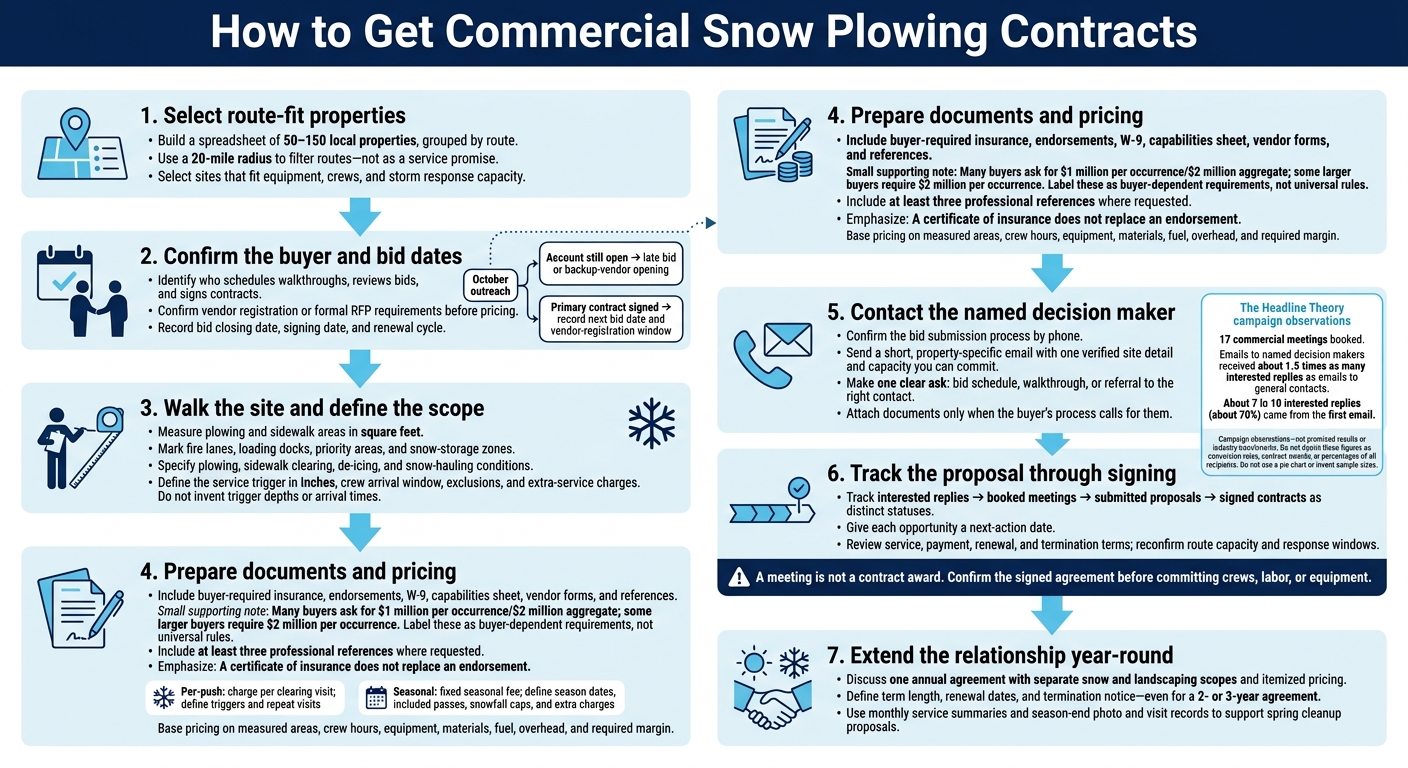 {How to Get Commercial Snow Plowing Contracts} :::
Identify Contract Buyers and Bid Dates
Choose Target Properties and Find Who Approves Contracts
Build a spreadsheet of 50–150 local properties, grouped by route. Use a 20-mile radius to filter routes - not as a service promise. Focus on nearby accounts that fit your equipment, crews, and storm response capacity. Skip any site your crews can’t cover during a storm. Then identify who can approve the contract for each property.
Record the management company and check each property’s approval chain instead of relying on a general buyer list. For firms such as CBRE, Cushman & Wakefield, or JLL, use LinkedIn to find the local portfolio manager or vendor coordinator. Don’t assume the on-site contact can award the contract.
Access isn’t the same as authority. Ask who schedules the walkthrough, who reviews bids, and who signs the contract. Before pricing the job, confirm whether you need to join an approved vendor list or respond to a formal RFP. Request registration instructions and the vendor packet, including the certificate of insurance, W-9, and capabilities sheet.
Schedule Outreach, Site Walks, and Contract Signing
Start outreach well before winter, working backward from each buyer’s actual deadline. Record the bid closing date, signing date, and renewal cycle. During walkthroughs, check priority doors, heated ramps, and special pavement coatings before setting your final scope. Use those dates to decide whether the account is still open this season or belongs in the next bid cycle.
Late in the season, focus on backup-vendor openings or late bids. If the primary contract is already signed, record the next bid date and vendor-registration window. Schedule your follow-up around renewal.
sbb-itb-0b9cb3a
Prepare Your Site Plan, Documents, and Pricing
Define the Service Scope and Storm Response
Turn your site walkthrough into a clear contract scope for the bid package. Measure plowing and sidewalk areas in square feet. Mark priority areas, including fire lanes and loading docks, along with snow-storage zones. Keep snow piles away from hydrants and roadway sightlines. Specify plowing, sidewalk clearing, de-icing, and the conditions that require snow hauling.
Set the service trigger in inches and state how soon crews will arrive. Make clear that work continues until the site is passable and safe. Confirm your equipment and crew assignments before promising coverage. Keep service logs and time-stamped photos, and spell out exclusions and extra-service charges in the agreement.
Provide Insurance and Vendor Documents
Build your bid packet around the property manager’s approval requirements. Include certificates of insurance, commercial general liability coverage, commercial auto coverage, workers’ compensation where required, and any requested additional-insured endorsements.
List the buyer’s required liability limits and endorsements. Many buyers ask for $1 million per occurrence/$2 million aggregate; some larger buyers require $2 million per occurrence. Buyers also often request a W-9, capabilities sheet, business registration, vendor forms, safety procedures, and at least three professional references.
Review coverage and required endorsements before signing. A certificate of insurance does not replace an endorsement. Buyers usually want these documents before reviewing your price.
Compare Per-Push and Seasonal Pricing
| Pricing model | Buyer’s cost and contractor’s risk | Suitable uses | Required definitions | Separately charged services |
|---|---|---|---|---|
| Per-push | Charge per clearing visit; more visits increase the buyer’s bill | Smaller lots with clear service triggers | Trigger depth, what counts as one plowing pass, and repeat visits during a storm | De-icing, hauling, and visits outside the agreed scope |
| Seasonal | Fixed seasonal fee, often paid in monthly installments; contractor carries more cost risk during heavy winters | Buyers seeking budget certainty | Season dates, included passes, snowfall caps, and extra charges above the cap | Work outside season dates, hauling, and services beyond stated limits |
A hybrid contract can pair seasonal lot clearing with hourly sidewalk work or hauling. Build your price from measured areas, crew hours, equipment costs, materials, fuel, overhead, and your required margin - not just a competitor’s rate.
Check local snowfall exposure and test whether a heavy winter could wipe out that margin. Set extra-service charges and snowfall caps before sending the bid, then submit the scope, documents, and pricing to the named decision maker.
Find Decision Makers and Send Direct Emails
Verify the Buyer and Bid Submission Process
Once your scope, insurance, and pricing are ready, find out who can accept your bid. Start with the property address and identify its management firm. Then use company websites, staff pages, LinkedIn, and directories to confirm the person who controls vendor selection for that property.
Call before emailing. Ask who handles snow services, how to submit a bid, and whether you need vendor registration or an approved-vendor slot.
Write a Short, Property-Specific First Email
Address the buyer by name and identify the property or portfolio. Include one verified site detail, the snow services you offer, your service area, and the equipment capacity you can commit. Attach your capabilities sheet and COI only if the buyer’s process calls for them.
End with one clear ask: the bid schedule, a site walkthrough, or a referral to the right contact. Focus on how your services fit the site, the scope, and the next step - not a broad sales pitch.
Keep follow-ups short and useful. Use accurate sender details and a clear opt-out. If the buyer shares a future bid date, plan your next contact around it rather than sending a generic email sequence.
Use The Headline Theory’s Campaign Results
This article is published by The Headline Theory. Its campaigns for snow removal clients booked 17 commercial meetings. Emails to named decision makers received about 1.5 times as many interested replies as emails to general contacts. About 7 in 10 interested replies came from the first email.
These results support a simple tactic: contact named decision makers rather than general inboxes. Make the first email property-specific, with follow-ups playing a supporting role. Treat the results as observations - not guarantees or industry benchmarks.
Track interested replies, booked meetings, submitted proposals, and signed contracts separately. Give each opportunity a next-action date.
If the account fits your route, use that same relationship to discuss landscaping as part of a year-round contract.
Bundle Year-Round Services and Plan Your Next Steps
Combine Landscaping and Snow Removal in One Contract
Offer the same buyer one annual agreement with separate snow and landscaping scopes. Once the property manager, facilities director, or HOA board shows interest, use that contract to extend the account beyond winter. Itemize pricing by service so the buyer can review the annual budget easily.
Keep contract terms separate from the service scope. Define service boundaries and specify whether snow work is seasonal or per-push. Include the term length, renewal dates, and required termination notice - even for a 2- or 3-year agreement.
Send monthly service summaries, then use season-end records to propose spring cleanup work. Photo logs and visit records help explain invoices and show where cleanup is needed.
Track Each Opportunity From Contact to Signed Contract
After sending a proposal, follow the deal through signing. Use a spreadsheet to record the named buyer, required vendor documents, completed walkthrough, proposal submission, signature, and current status for each opportunity. If the buyer accepts electronic signing, use DocuSign or another secure signature tool.
A meeting is not a contract award. Review the service, payment, renewal, and termination terms. Before scheduling work, confirm that your crews and equipment can meet the response windows on your route. Don’t schedule crews, commit labor, or allocate equipment until you have the signed agreement.
FAQs
How do I win contracts without commercial references?
Start with property-management vendor lists and condo/HOA bidding processes. These may not require references upfront. Email the portfolio manager or vendor coordinator your capabilities sheet, insurance documentation, and W-9, as requested. Offer references “on request.”
Submit a complete proposal that matches the RFP’s scope. Include safety and insurance details, photo documentation, and clear pricing. Persistence matters more than polish.
How do I price a backup snow plowing contract?
Balance predictable revenue with what the client can afford. Backup work usually uses per-event, per-push, or hourly pricing instead of a fixed seasonal rate. Factor in the costs of immediate deployment and keeping equipment ready.
Set clear service limits and snow-depth triggers so both sides know when work starts and what gets billed. Record time, materials, and site conditions, and take before-and-after photos to support invoices and help prevent billing disputes.
Backup service often covers primary contractor failures or extreme weather.
How do I set a profitable seasonal snowfall cap?
Use your past job costing data to set a seasonal snowfall cap that balances fixed costs against the risk of an above-average winter. Specify the snowfall threshold in your contract, along with how you’ll bill for accumulation or events beyond that limit.
Discuss extreme-weather risks during negotiations so clients understand what’s covered and when extra charges apply. This gives them budget certainty while ensuring you’re paid for the added labor and equipment use during heavy-snow seasons.