How to Get Commercial Landscaping Contracts With Property Managers
· 6 min read

To win commercial landscaping contracts, start with properties your crews can serve profitably, find out who controls bids, and ask when contracts renew. Before pricing, confirm the budget, required work, insurance needs, and approval process.
Here’s the process:
- Target the right properties: Keep routes tight and identify who requests bids and who approves hiring.
- Agree on the work: Walk the site with the manager, record conditions, and confirm service frequency and exclusions.
- Make the bid easy to review: Include clear pricing, service standards, required documents, and after-hours contacts.
- Follow through: Confirm receipt, get the signed agreement and vendor approval, then brief your crew.
- Track results: Record follow-up dates, wins, contract revenue, and gross margin.
Agree on the scope before setting the price. If the budget drops, adjust the work - not just your rate.
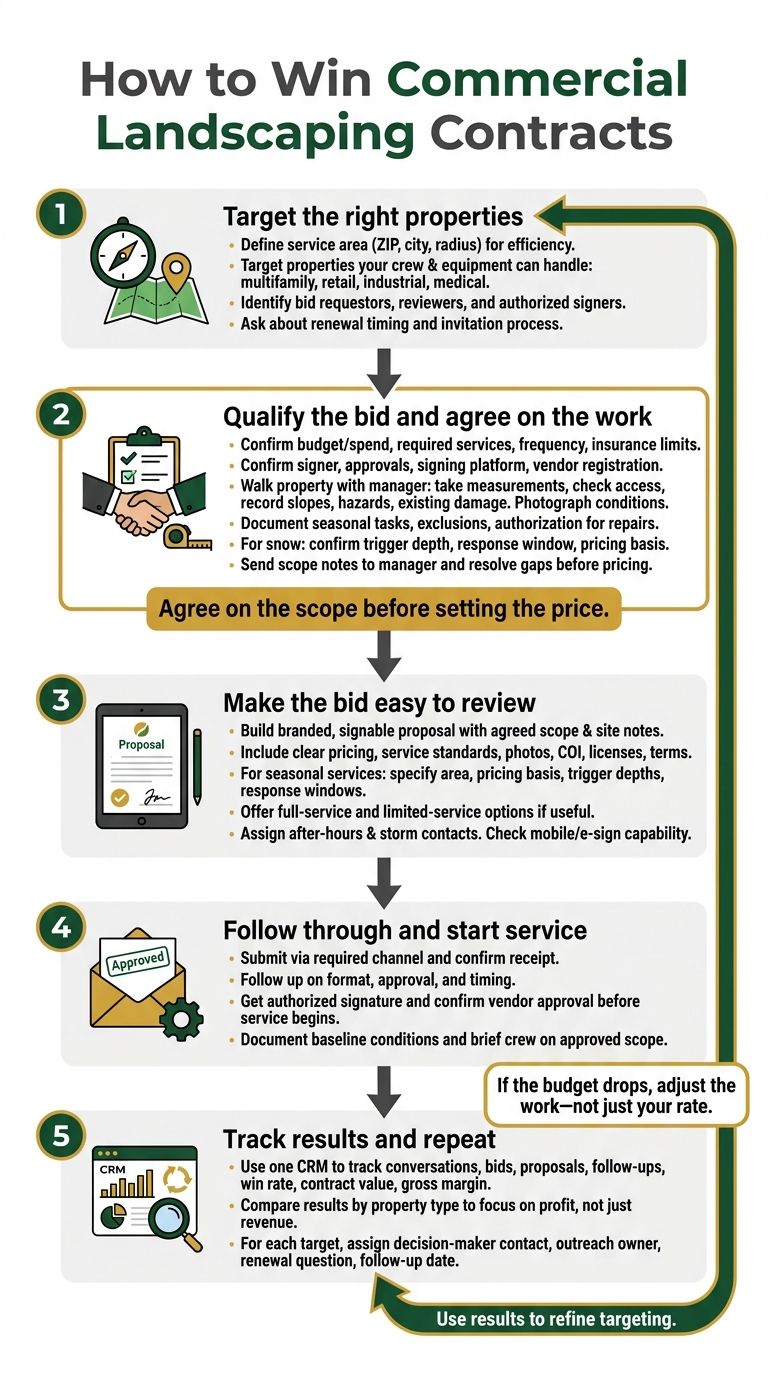
How to Win Commercial Landscaping Contracts
1. Find Properties and Contact Decision-Makers
Set Your Service Area and Target Properties
Define your service area by ZIP code, city, or radius to keep routes efficient. Target properties your crew and equipment can handle, whether that’s multifamily communities, retail centers, industrial sites, or medical properties.
Check building permit records, too. They can help you spot recent improvements and estimate a property’s likely service needs and budget.
With your route mapped out, find out who controls the bid.
Identify the Bid Contact and Decision-Maker
A target list won’t get you far unless you can reach the right person. Ask the management office who requests bids, who reviews proposals, and who approves and signs. These tasks often belong to different people. Property managers, HOA boards, and facility directors often make the call.
Reach Out Before Contract Renewals
Start outreach before the renewal window. Ask when the property reviews vendors and what you need to do to receive an invitation to bid. Keep your message short and focused on the bid process, rather than a sales pitch.
Subject: Landscaping bid process for your property
Hello, could you point me to the person who handles landscaping maintenance bids for this property? When do you next review vendors, and what steps are required to receive an invitation to bid?
If your email goes unanswered, follow up by phone. If bidding has closed, ask when the next review cycle starts and whether you can reconnect then.
Use Email and Phone Together - and Reach the Named Decision Maker
This article is published by The Headline Theory, which runs cold email and cold calling to property managers for commercial landscapers. Since November 2025, its commercial landscaping campaigns have produced 1,808 interested replies and 378 booked meetings with commercial decision makers. Emails sent to the named decision maker drew about twice as many interested replies per contact as emails sent to a general contact.
Client example: Mighty Oak Landscaping in Suwanee, GA, got 14 appointments in 10 weeks and closed 7 of them for $200,000 in annual recurring revenue. These are company-reported results, not a promise of what you'll get.
The takeaway: find the person by name before you reach out, and follow an unanswered email with a call.
2. Qualify the Bid and Inspect the Property
Once the property manager responds, confirm the scope, budget, and approval requirements before pricing the job. This helps you decide whether the invitation to bid is worth pursuing.
Confirm Service Needs, Budget, and Approval Steps
Ask for the budget range or current spend before preparing a proposal. There’s no point spending hours estimating an account that doesn’t fit.
Confirm which services the client needs, how often they need them, and whether they prefer a monthly flat rate, a per-visit rate, or an hourly rate. Check insurance limits and additional insured requirements before committing time to a detailed site walk.
Find out who signs the agreement, whether a board or owner must approve it, and which platform they use for signing. Also ask whether you’ll need to complete vendor registration. Once the scope and approval steps are clear, schedule the walk.
Walk the Property With the Property Manager
Use the walk to agree on the work - not just inspect the grounds. Take measurements and record observations that support your pricing and set clear scope boundaries. Measure gate widths to check equipment access. With permission, photograph existing damage and note slopes, drainage, hazards, and liability risks.
Document service frequencies, seasonal tasks, exclusions, and who can authorize repairs. If the job includes snow service, confirm the trigger depth, response window, pricing basis, and how larger storms will be handled.
Before pricing, send your scope notes to the manager and resolve any gaps so the proposal reflects the agreed work. Use those notes to build the bid package.
3. Submit the Proposal and Close the Contract
Price the Work and Explain Your Service Plan
Once you agree on the scope, turn your site notes into a proposal the manager can review quickly. Use a branded, signable document with photos, a certificate of insurance (COI), licenses, and terms attached.
For seasonal services, specify the service area, pricing basis, trigger depths, and response windows. If it helps the buyer compare choices, offer clear tiers, such as full-service and limited-service options. State who handles after-hours and storm calls.
Use a Bid-Readiness Checklist
Check for missing items before you submit the proposal.
| Requirement | Status | Owner |
|---|---|---|
| Scope and price basis documented | ☐ Confirmed | Estimator |
| Service triggers defined | ☐ Confirmed | Sales |
| Certificate of insurance, licenses, and terms attached | ☐ Complete | Office |
| Legal entity name matches registration records | ☐ Verified | Office |
| Portfolio photos or project case studies included | ☐ Complete | Sales |
| Required background checks prepared | ☐ Ready | Operations |
| Mobile-friendly and e-signable | ☐ Ready | Sales |
| After-hours and storm contacts assigned | ☐ Ready | Operations |
| Renewal, cancellation, and contract attachments reviewed | ☐ Reviewed | Owner |
| Follow-up date assigned | ☐ Scheduled | Sales / Operations |
Follow Up, Sign the Agreement, and Start Service
Submit the proposal through the required channel and confirm receipt. Follow up with questions about format, approval, and timing. Make the package easy to review and sign on a phone - without an account or app download.
Before offering a discount, address price objections by comparing scope, frequency, and exclusions. If the budget changes, adjust the scope and price together. Don’t promise the same work for less.
Match crew instructions to the approved scope from the site walk. Get the authorized signature, confirm vendor approval, and document baseline conditions before service begins.
Conclusion: Track and Repeat Your Sales Process
Build a repeatable process around profitable properties, and keep each bid moving from outreach to close.
Review your pipeline regularly. Use one CRM to track conversations, meetings, bid invitations, proposals, win rate, recurring contract value, and gross margin. Compare results by property type to focus on work that delivers profit - not just revenue.
Let those numbers guide your next round of outreach. For each target property, assign a decision-maker contact, an outreach owner, one renewal question, and a follow-up date. Repeat the same workflow until your pipeline becomes predictable.
If you'd rather have the prospecting done for you, see how commercial landscaping lead generation works, or read our comparison of lead generation agencies for commercial landscaping companies.
FAQs
How early should I reach out before a landscaping contract renews?
Contact the property well before the current contract ends to get a signed contract in place. Property managers and facility directors often take time to process renewals, and negotiations rarely succeed once the season starts. Ask when the next vendor review happens and put that date in your CRM.
For snow work, see how to get commercial snow plowing contracts.
How do I price commercial landscaping contracts profitably?
Profitable commercial landscaping contracts start with accurate cost estimates. Account for project size, product availability, client goals, and liability insurance.
Spell out the scope, assumptions, exclusions, and hourly rates for extra services. Itemize fees so clients know what they’re paying for - for example, per-visit rates for maintenance or hourly rates plus materials for installations. Match material quality to the client’s budget.
How can I win bids without commercial landscaping references?
Show clients they can count on you with detailed fee breakdowns, proof of full insurance coverage, and documented service standards. Shape your proposal around the property’s needs, highlighting maintenance schedules or irrigation expertise where relevant.
Include business credentials, active licensing, and experience with similar properties. A branded digital proposal that covers all the details can also help build confidence in your business.
Related posts
One company per service area. See if yours is still open.