How HVAC Companies Win Commercial Maintenance Contracts
· 8 min read
To win commercial HVAC maintenance contracts, start with properties you can serve profitably - not a bigger call list. Confirm who approves the agreement and when the current contract’s notice window closes before you pitch.
This article is published by The Headline Theory, which reports 80 commercial meetings booked for HVAC clients since November 2025 through cold email and calling. That’s a measure of outreach - not signed contracts or revenue.
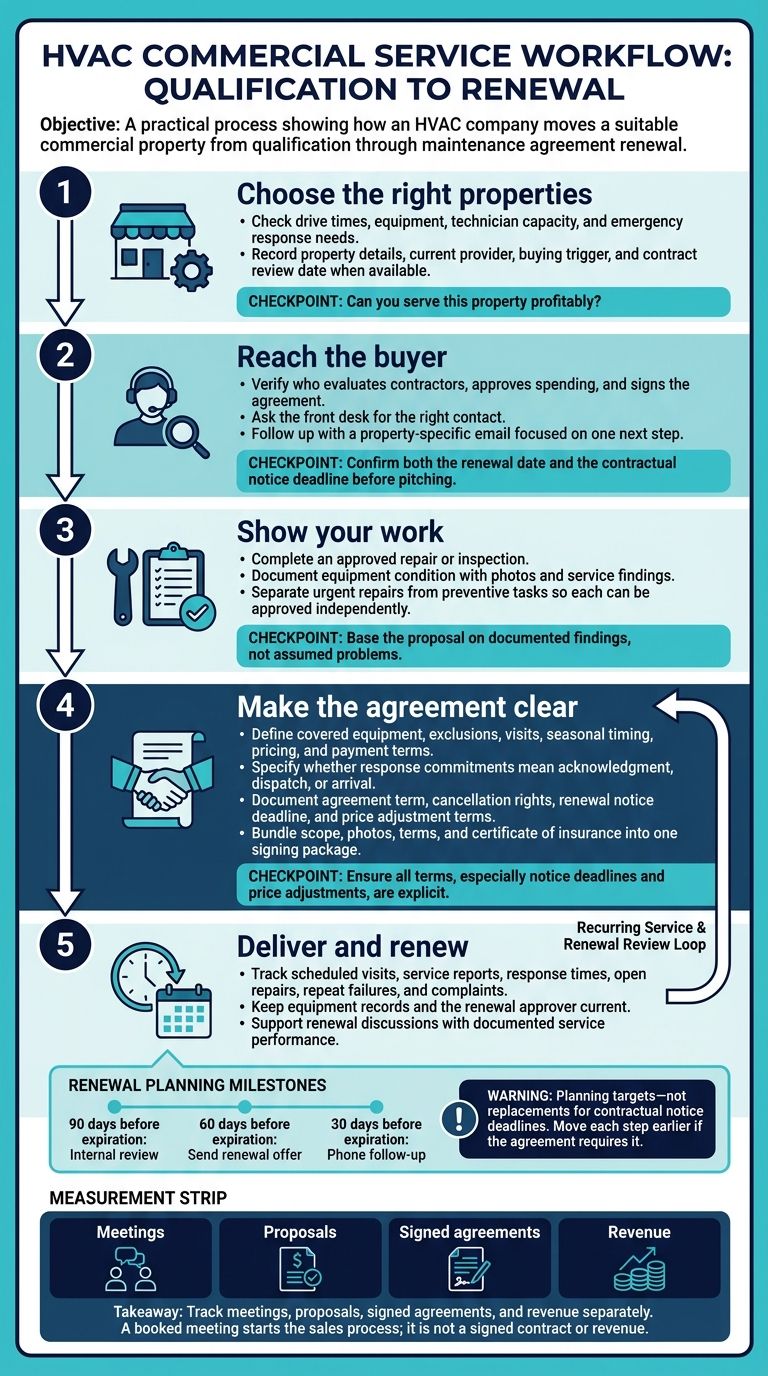
Here’s the process to turn outreach into recurring work:
- Choose the right properties: Check drive times, equipment, technician capacity, and emergency response needs.
- Reach the buyer: Verify approval roles, ask the front desk for the right contact, and follow up with a property-specific email.
- Show your work: Use an approved repair or inspection to document equipment condition and separate urgent repairs from preventive tasks.
- Make the agreement clear: Define covered equipment, visits, response times, pricing, exclusions, and payment terms.
- Deliver and renew: Track service reports and open repairs, then begin renewal talks before the contractual notice deadline.
Track meetings, proposals, signed agreements, and revenue separately. A booked meeting starts the sales process. Documented service and clear terms help turn it into a lasting account.
Find Properties That Fit Your HVAC Business
Qualify Each Property Before Outreach
Set your service limits before building a prospect list. Poor-fit properties waste time and slow recurring revenue. Define your service radius, then check drive times and traffic - not just mileage. Make sure your technicians have the skills and capacity to service each building’s equipment. Check whether you can meet emergency response requirements, handle paperwork such as manufacturer warranty claims, and fit the account into your dispatch schedule.
For each property, record its type, size, location, equipment complexity, current provider, recent failures, and contract review date, when available. Leave unknown fields blank, then verify them before outreach.
Identify Buying Triggers and Approval Steps
Watch for contract renewals, new ownership, a new facility director, and repeated equipment failures. Service contracts usually run for a fixed term with a notice window for cancellation or renewal. Ask for both the renewal date and the notice deadline so you can reach out before that deadline passes.
Before preparing a proposal, confirm who evaluates contractors, approves spending, and signs the agreement. Ask:
“Who reviews the maintenance scope, and who gives final approval?”
Record vendor onboarding requirements alongside those names. Knowing the buying trigger and approval process helps you reach the right contact directly.
Build Your Property Contact List
Create one record per property in your CRM or spreadsheet to track outreach and approvals. Include the address, responsible contacts, their roles, buying trigger, review date, information source, and next action. Apollo or ZoomInfo can help you find likely contacts, but verify that each person still handles that responsibility before reaching out. Keep separate contacts for technical review and purchasing approval.
Use these records to guide commercial HVAC outreach. Track meetings, proposals, signed agreements, and revenue separately to see which properties turn into profitable contracts.
Reach the Maintenance Agreement Decision Maker
Confirm Each Contact’s Role and Authority
Once you’ve mapped the buying trigger and approval path, find the person who can sign the agreement. Check LinkedIn, building directories, property management sites, and B2B data tools to verify who signs, who approves, and who manages the site. Call the signer first, then work through other contacts as needed.
| Role | Outreach focus | Information to confirm |
|---|---|---|
| Facility director | Long-term reliability and operating costs | Budget authority and renewal deadlines |
| Property manager | Response times and tenant comfort | Contract expiration and service concerns |
| Maintenance director | Preventive maintenance and technical support | Equipment inventory and service history |
| Building engineer | Equipment troubleshooting and daily support | Equipment issues and site access |
| Ownership group | Asset protection and financial transparency | Final approval requirements and contract terms |
Ask the Front Desk for the Right Contact
Ask for the role you identified rather than defaulting to the general manager. Keep it brief: ask who handles HVAC maintenance for [property name], and explain why you’re calling. Mention a repair finding or warranty claim only if one exists.
If the contact isn’t available, request their full name, title, business email, and best callback time. The front desk can help you reach the approver - it’s not a failed call.
Expect this often. In the first four weeks of The Headline Theory’s cold calling program (Oct–Nov 2026), callers reached a live person on about 27% of dials (n = 1,086 dials), and about 4 in 10 of those conversations reached a gatekeeper rather than the decision maker (n = 296 conversations).
Send a Property-Specific Follow-Up Email
Send the follow-up right after your call. Focus on the property, a confirmed issue, and one next step. Refer only to the contact you reached and the property issue you discussed. If you haven’t confirmed a problem, ask about maintenance needs instead. Include your name, HVAC company, and direct phone number.
Use this phone outreach and follow-up guidance to keep calls and emails focused on the same property need. The email should set up the first visit and explain the scope you’ll document there.
Turn Your First Service Visit Into a Maintenance Proposal
Use the first visit to document the building, complete the service work, and turn your findings into a maintenance proposal.
Document Your Work and Maintenance Findings
Take site photos, complete the approved repair or inspection, and record the equipment’s baseline condition. Document completed work, unresolved risks, and preventive recommendations. Separate urgent repairs from preventive work so the buyer can approve each independently. If you find a warranty issue, record the claim details and supporting documents.
The Headline Theory’s HVAC campaigns include Clear Heating & Air’s $40,000 in new commercial jobs and $150,000 in pipeline, plus Northstar HVAC/R’s $100,000 in pipeline in one month.
Set the Scope, Visit Schedule, and Response Times
Build the agreement around that baseline. Attach an equipment inventory and flag any details that still need verification. Specify covered equipment, exclusions, visit frequency, and seasonal timing. Spell out the inspections, cleanings, checks, and report items included in the agreement.
Match response commitments to the property’s operating needs. Make clear whether each deadline refers to acknowledgment, dispatch, or arrival, and name the after-hours escalation contact. Don’t promise repair completion before diagnosis or guarantee that maintenance will prevent every failure.
Explain Pricing and Contract Terms
Choose a pricing structure you can deliver profitably. When useful, offer two or three coverage levels. Show exactly how tasks, visits, and response commitments differ rather than relying on vague “premium” benefits.
| Pricing structure | Predictability | Scope flexibility | Admin burden | Margin risk |
|---|---|---|---|---|
| Fixed recurring maintenance fee | Predictable fee for defined maintenance | Changes require revised scope | Track scheduled work against the fee | Underestimated labor or consumables |
| Tiered plans | Predictable within the selected level | Buyer chooses defined coverage | Maintain clear differences between plans | Benefits priced below delivery cost |
| Base agreement + separately approved repairs | Predictable maintenance fee; variable repair spending | Repairs approved as needed | Separate estimates and approvals | Unpaid diagnostic work or repairs performed without approval |
State what the maintenance fee covers and what you bill separately. Document the payment schedule, agreement term, cancellation rights, renewal notice deadline, and price adjustment terms.
Bundle the scope, photos, terms, and certificate of insurance into one signing package. Before sending it, check the agreement against state and local liability, insurance, and renewal rules.
Deliver the Service and Renew the Agreement
Track Visits, Reports, and Unresolved Repairs
Schedule visits ahead of time, then check that service meets the agreed schedule and response times. Send reports to the designated contact, update equipment records after every visit, and store reports in a client portal. Keep track of open repairs, repeat failures, and complaints so nothing gets lost between visits.
Use a retention checklist to track agreement status, completed visits, open repairs, complaints, the renewal date, current scope, pricing, and the renewal approver. Check it before account reviews. These records can help you spot renewal risks before the contract enters its notice window.
Begin Renewal Before the Notice Deadline
Once service is running smoothly, start renewal discussions early enough to avoid a rushed decision. Plan your internal review well before expiration, send the renewal offer early, and follow up by phone before the contractual notice deadline.
Review service performance, equipment changes, open repairs, and pricing. Support the renewal offer with records of completed visits and response times. Confirm who can approve the renewal, and check the notice deadline, cancellation terms, and price-adjustment language. Make automatic-renewal terms easy to spot. Send the final offer for e-signature to skip printing and scanning delays.
Conclusion: Repeat Your Prospect-to-Renewal Process
Keep the same account record from first outreach through renewal. Track qualified meetings, proposals, signed agreements, service issues, and renewals separately so you can see where recurring revenue breaks down.
If you'd rather have outreach handled for you, compare the best lead generation companies for commercial HVAC contractors.
FAQs
How do you price commercial HVAC maintenance profitably?
Set your pricing based on a detailed equipment inventory, visit frequency, response time guarantees, and specific maintenance tasks - not a one-size-fits-all estimate. During the first repair or inspection, document the equipment’s condition. Then use those findings to shape the agreement around the labor and parts the equipment needs.
Give facility directors and property managers clear, written estimates that explain the scope of work and pricing in plain language. Be upfront about costs, with no hidden charges, to help build trust.
How do you win over properties with an existing HVAC provider?
Be the more reliable choice when service falls short, equipment breaks down, or ownership changes. Show that you act before problems grow. Use the first repair or inspection to prove your worth with thorough documentation and a clear report.
Offer a maintenance proposal that spells out the equipment covered, visit frequency, scope of work, response times, reporting, and transparent pricing. Keep the contract through consistent service, clear communication, and follow-up.
How do you handle repairs outside the maintenance scope?
State clearly in your preventive maintenance contract that coverage includes inspections and routine servicing only. Repairs outside that scope are billed separately - not included at no charge.
If your technician finds an out-of-scope repair, have them document the issue, provide the facility manager with an estimate, and get approval before starting the work. This helps your client plan for costs and protects your service agreement’s profitability.
Related posts
One company per service area. See if yours is still open.