When Do Property Managers Sign Commercial Snow Removal Contracts?
· 7 min read

Property managers usually sign snow removal contracts before the season starts, at the end of their own budget and bid review; public buyers follow published bid deadlines. So the date that matters is when each property reviews vendors and needs pricing - not just when the current contract ends.
Here’s how to time your outreach:
- Before winter: Work backward from budget and approval dates to get commercial snow plowing contracts, leaving time for a site walk, pricing, insurance checks, and service terms.
- For public contracts: Follow the buyer’s published bid deadlines and check renewal options.
- After the first storms: Ask about backup or replacement needs, but only offer work your routes can handle.
- For next season: Record the buyer’s review date and schedule a callback well before it.
The key: reach the person who can approve the work, confirm the property’s needs and pricing format, and plan around their calendar.
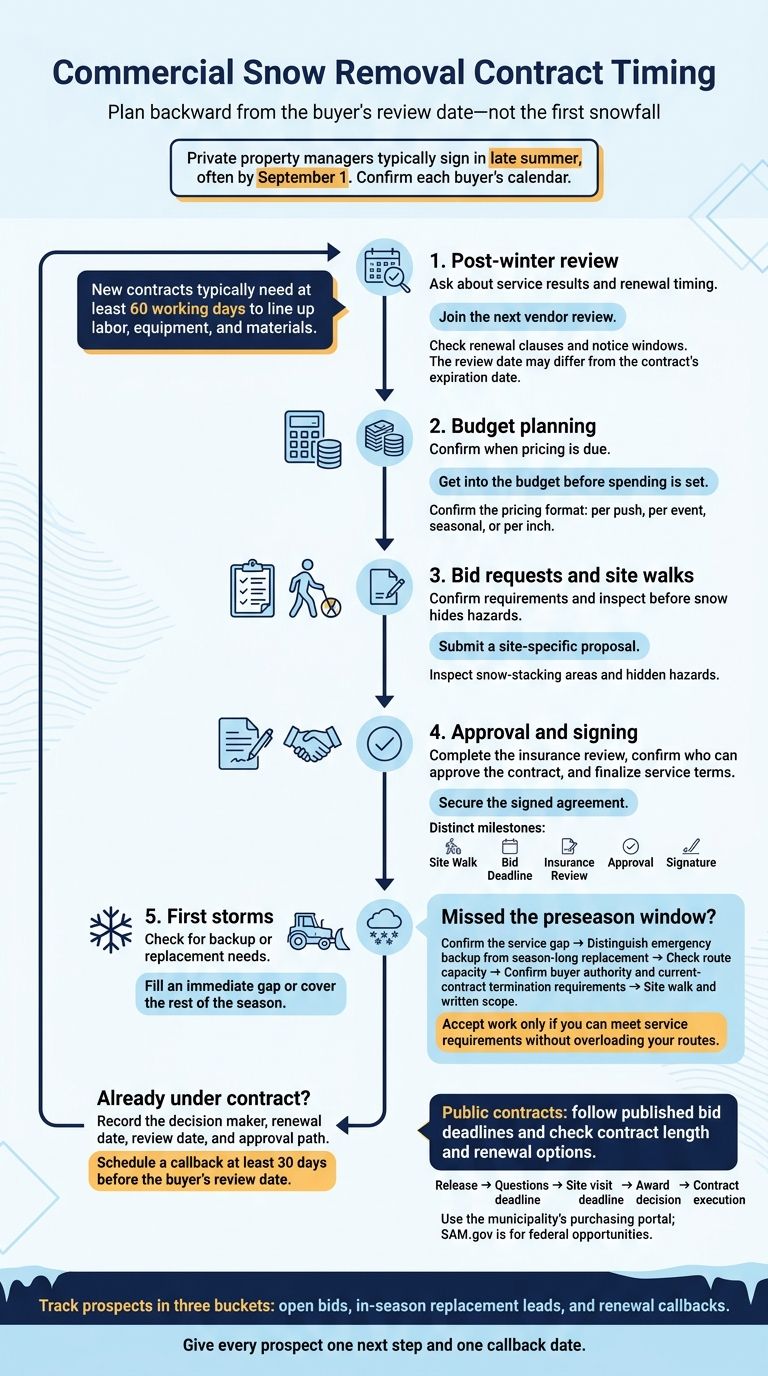
Follow the Annual Budget, Bid, and Signing Calendar
Follow each buyer’s annual calendar, not a fixed national schedule, to time your outreach, bids, and follow-ups.
| Buyer stage | What you should do | Contract opportunity |
|---|---|---|
| Post-winter review | Ask about service results and renewal timing. | Join the next vendor review. |
| Budget planning | Confirm when pricing is due. | Get into the budget before spending is set. |
| Bid requests and site walks | Confirm requirements and inspect before snow hides hazards. | Submit a site-specific proposal. |
| Approval and signing | Complete the insurance review, confirm who can approve the contract, and finalize service terms. | Secure the signed agreement. |
| First storms | Check for backup or replacement needs. | Fill an immediate gap or cover the rest of the season. |
After Winter: Ask About Reviews and Budgets
Ask when the buyer reviews renewals and when budget pricing is due. Check renewal clauses and notice windows, too. The review date may differ from the contract’s expiration date. Use that review date to map out the bid, approval, and signature deadlines.
Before Winter: Track Bids, Approvals, and Signing
Track the site walk, bid deadline, insurance review, approval, and signature as separate milestones. Confirm who can approve the agreement and which steps must happen before it reaches that person.
Inspect snow-stacking areas and hidden hazards before snow arrives. Finalize service terms before signing, and allow time for revisions. If the buyer misses this window, the next opening may come after the first storms.
After the First Storms: Check for Replacement Needs
Missed visits, slow responses, poor communication, or an overloaded vendor can put the contract back in play. When service fails after the first storms, you’re filling a gap - not competing for a standard renewal.
Emergency backup and a season-long replacement are different jobs. Confirm which service the buyer needs and whether your route has room for it.
Before scheduling work, confirm the buyer has authority to approve it. Have the buyer review the current contract’s termination terms, notice requirements, and any time the vendor must be given to fix the problem before termination.
Next, match this calendar to the property type and contract structure.
Match Your Timing to the Property and Contract
Private Properties: Check Who Approves and When
With your calendar set, match your outreach to the buyer type. Know who can sign, who controls the budget, and what could prompt a vendor change. Use the roles below as questions to ask - not fixed schedules. Your contact may need approval from an owner, board, or regional manager.
Before you pitch, ask whether the buyer uses per-push, per-event, seasonal, or per-inch pricing. Each contract type can follow a different sales timeline.
| Property type | Usually signs or approves | Approval requirements to confirm | Replacement trigger |
|---|---|---|---|
| Retail centers | Property manager, regional manager, or owner | Tenant coordination; high-traffic safety | Blocked entrances; loss of parking stalls |
| Office parks | Facility manager | Employee access; shift-change coordination | Missed clearing deadlines |
| HOAs | Board of directors | Board vote; budget meeting alignment | Resident complaints; icy sidewalks |
| Apartment communities | Property manager | Pedestrian safety; tenant parking access | Slip-and-fall incidents; blocked carports |
| Healthcare facilities | Director of facilities; risk manager | Emergency access; vendor qualification | Any accumulation; ambulance path obstruction |
Ask each one directly when its review happens. Timing varies by property and by owner, so use the answer rather than a rule of thumb.
Check credential requirements, too. Some buyers want SIMA membership, ASM training, or CSP certification before signing.
Municipalities: Track Published Bid Deadlines
Public buyers follow a published process; private buyers follow an internal one. Track the release date, questions deadline, site visit, bid deadline, award decision, and contract execution. Use the municipality’s purchasing portal - SAM.gov is for federal opportunities.
Read each solicitation for mandatory site visits, submission rules, and required insurance or bonds. Then work backward from the service-start date to leave enough preparation time.
Before treating a public account as an annual opportunity, check the current contract’s length and renewal options. A renewal could keep the incumbent in place without a new bid. Follow published addenda so you don’t miss changed requirements or deadlines.
With the bid timeline mapped out, confirm how the buyer wants the contract priced before preparing your quote.
Contract Pricing: Know What Buyers Need Before Signing
The pricing structure determines what buyers need to review - and how much time to leave before signing.
| Contract type | What to settle before signing | Timing implication |
|---|---|---|
| Per push | Service trigger, rate per visit, and repeat visits during a storm | Allow time to agree on when each billable visit begins. |
| Per event | What counts as one event and which services it includes | Resolve event boundaries before the first storm you cover. |
| Seasonal | Covered dates, included services, snowfall limits, and overage terms | Submit pricing for the budget review so the buyer can approve the seasonal commitment. |
| Per inch | Measurement source, accumulation brackets, and billing method | Allow time to agree on how snowfall determines the charge. |
Ask when pricing is due for review, not just when the contract expires. Rate approval doesn’t settle every detail; leave time to finalize service terms before coverage starts.
Find Openings After Your Local Season Starts
If the preseason signing window has closed, focus on replacement and renewal opportunities. Look for properties with a clear need: a vendor who fell short, no backup coverage, or a service gap after the first storm. Confirm the need before writing a proposal.
Check Your Capacity Before Offering Coverage
Before promising coverage, make sure the property fits your route capacity. If it does, move straight to a site walk and a written scope.
Document the remaining work, priority areas, and hazards. Snow-covered pavement can hide obstacles, so spell out the scope, trigger conditions, and response terms in writing.
Already Under Contract? Set a Renewal Callback
Ask when the agreement expires or renews, when vendor review begins, who approves the next contract, and when to reconnect. If the property is locked in now, the review date is your next opening. Log that date and schedule a callback well before it.
This article is published by The Headline Theory, which runs cold email and cold calling for snow removal and other commercial service companies. In the first four weeks of its cold calling program (Oct–Nov 2026), 4% of 296 live conversations with commercial properties were already under contract and 41% reached a gatekeeper. Log callback dates for contracted accounts, and use gatekeeper conversations to get the decision maker's name.
Its snow removal email campaigns produced 68 interested replies and 17 meetings with commercial decision makers, and emails sent to the named decision maker drew about twice as many interested replies per contact as emails to a general contact. If you'd rather have this outreach done for you, see commercial snow removal lead generation.
Line Up Next Season's Contracts During This One
Record the decision maker, renewal and review dates, approval path, and key lessons learned. Use those details to time next season’s outreach.
Conclusion: Plan Backward From the Buyer's Review Date
Build your schedule around the buyer’s review date - not the first snowfall. Account for the property type, approval path, and contract structure. Ask when budget approval begins and when the award decision will be made. Then work backward, leaving time for a site walk, proposal review, approval, and a final review before signing.
If the preseason window has closed, focus on replacement work and renewal callbacks. Accept replacement work only if you can meet service requirements without overloading your routes. Otherwise, log the account for a callback next season.
Track prospects in three buckets: open bids, in-season replacement leads, and renewal callbacks. Assign each prospect one next step and one callback date based on the buyer’s decision timeline.
FAQs
How early is too early to contact property managers?
It’s rarely too early. Right after the season ends is a good time to connect, while property managers review how the winter went and plan for the next one.
Reaching out during that review leaves time to build a relationship, schedule site walks, and discuss contract terms before the fall rush.
When should you follow up on an unsigned snow contract?
If your prospect is already under contract, ask when it renews. Record the date and set a reminder to follow up before their next renewal or contract review begins.
How do multiyear contracts affect your outreach timing?
Multiyear contracts mean fewer properties shop for new vendors each season. If a prospect is under contract, ask when the agreement renews. Log that date in your CRM and schedule a callback before the property starts its internal review.
Stay in touch and share industry updates so the property sees you as a reliable alternative when it weighs extending the agreement or requesting bids.
Related posts
One company per service area. See if yours is still open.