Who Can Book Meetings With Commercial Property Managers for Your Company?
· 10 min read

You have 5 ways to get meetings with commercial property managers: do the outreach yourself, hire a sales rep, use an agency, buy shared leads, or get referrals. Start with your bottleneck: limited prospecting time, a staffing gap, or too few introductions.
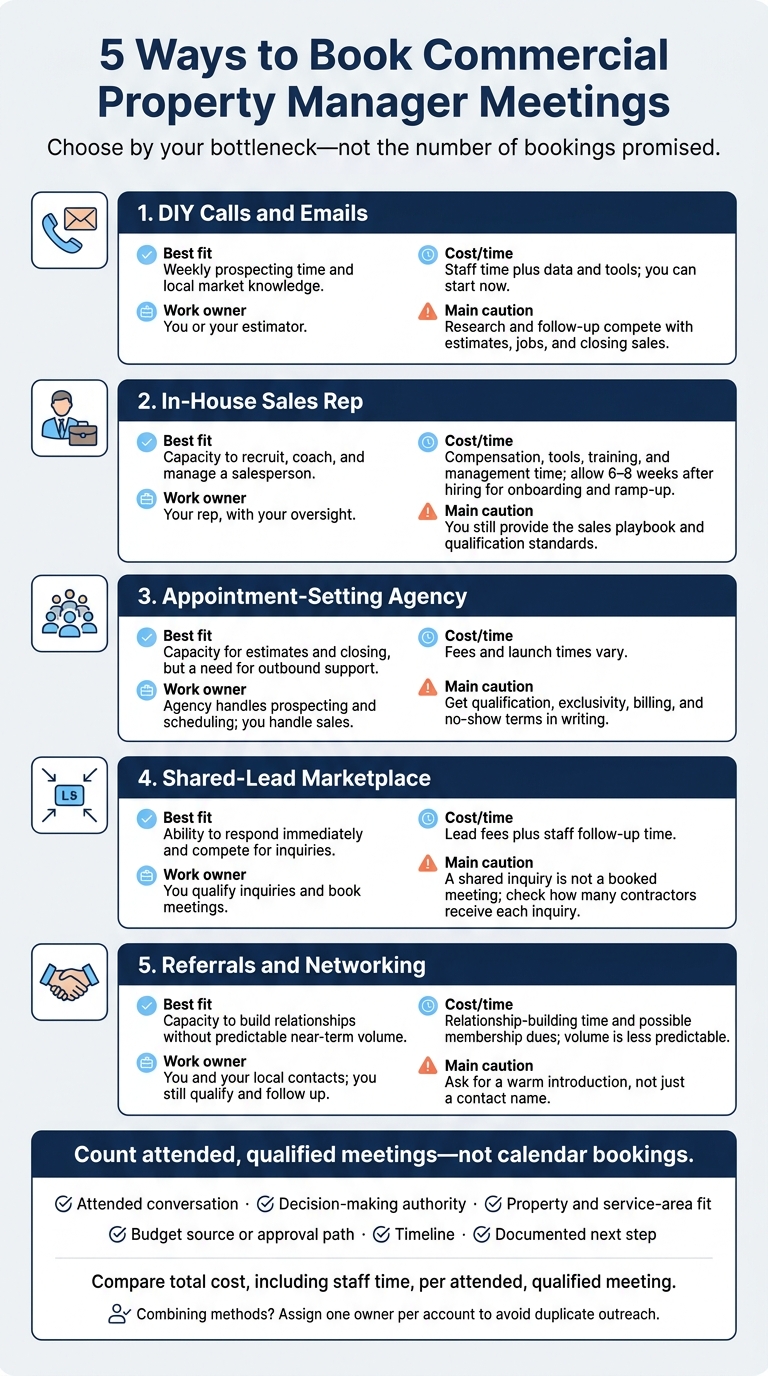
Count attended, qualified meetings - not calendar bookings. Confirm the buyer’s authority, property fit, budget or approval path, and timeline. Then compare total cost, staff time, speed, and exclusivity.
Quick Comparison
| Method | Who does the work? | Cost and timing | What to check |
|---|---|---|---|
| DIY calls and emails | You or your estimator | Staff time plus data and tools; you can start now | Can you keep up with follow-up? |
| In-house sales rep | Your rep, with your oversight | Pay, tools, and training; allow time for recruiting and ramp-up | Can you train and manage the rep? |
| Appointment-setting agency | Agency handles outreach; you handle sales | Fees and launch times vary | Written qualification, exclusivity, and no-show terms |
| Shared-lead marketplace | You qualify inquiries and book meetings | Lead fees plus follow-up time | How many contractors receive each inquiry? |
| Referrals and networking | You and your local contacts | Time, possible dues, and less predictable volume | Is there a warm introduction to the buyer? |
Compare cost per attended, qualified meeting, including your team’s time. A shared inquiry, a booked slot, and a sales opportunity are not the same thing.
5 Ways to Book Commercial Property Manager Meetings
1. Calling and Emailing Prospects Yourself
You or your estimator takes care of research, outreach, scheduling, and follow-up. Start with county assessor records, permit filings, or tools like CoStar or Reonomy to find the property manager, facility director, or building engineer for your target buildings. Ask the engineer about technical details and the manager or asset manager about budget decisions.
Once you find the right contact, you can start reaching out. Keep your first email under 150 words and mention the property or a recent permit. Follow up with calls over two to three weeks. Log each contact and next step in a CRM like HubSpot so you’re not relying on memory.
Before booking a meeting, confirm the decision maker, budget, and timeline. If an existing contract prevents a conversation, ask when it renews and how they review replacement vendors. Save those details and plan your next contact around that window.
Your main cost is time, plus any paid data or software. Set aside one outreach session each week - otherwise, estimates and service calls can take over. DIY works best when you or your estimator knows the local market and can make time for targeted research and steady follow-up, rather than just building a bigger list. If prospecting keeps getting pushed aside, the next option is hiring someone to book meetings.
2. Hiring an In-House Sales Representative
Hiring a full-time sales rep keeps outreach moving without pulling you off the job. That person handles list building, outreach, qualification, CRM updates, and scheduling. Have them research each building - not just the company name - and connect each address to its owner, property manager, on-site engineer, and regional lead. Keep notes and follow-ups in your CRM.
You still provide the sales playbook. Set your service area, target property types, and priority accounts. Train the rep on your commercial services and buying signals, such as aging equipment or ownership changes. Write down the outreach script and the steps for reaching the right contact with the right message at the right time.
Hiring takes time. Once recruiting is complete, plan for an onboarding and ramp-up period before the rep is fully productive. Your budget needs to cover compensation, prospect data, CRM and outreach tools, and your training and management time. Review calls and walkthroughs weekly, then check the budget and workload monthly.
Put qualification standards in writing: the decision maker must be present, and the budget and timeline must be confirmed. Require notes on the current vendor, service need, and renewal window. Measure qualified meetings, not calendar bookings. If you need meetings sooner than hiring allows, compare appointment-setting agencies next.
3. Using an Appointment-Setting Agency
An agency handles prospecting and scheduling. You still attend meetings, run walkthroughs, and prepare quotes. Outreach can use cold calling, cold email, or both: calls let reps address objections live, while email lets them send personalized messages at scale. Ask to review actual messages and calls, and check that targeting stays within your service area and property types. Qualified meetings matter more than filled calendar slots.
This article is published by The Headline Theory, an appointment-setting agency. Its SDR team uses personalized cold email and one-to-one cold calls to reach property managers, facility directors, and building engineers. It works with one client per service line in each service area. The team has booked 500 commercial meetings for clients (see client results), with a median of 3 days from first email to first meeting. Every meeting is qualified for decision maker, budget, and timeline.
Clear Heating & Air in San Diego used a pay-per-meeting service that delivered five meetings, three without a decision maker; with The Headline Theory, it later closed $40,000 in new commercial jobs and built $150,000 in pipeline.
That pipeline is potential business - not closed revenue.
Abstrakt Marketing Group lists outbound BDR programs starting at $5,000 per month. It also offers a Results Portal with call visibility. When comparing agencies, check setup charges, monthly retainers or per-meeting fees, minimum terms, cancellation notice, launch dates, and time to first meeting.
Before signing, put these details in writing:
- Exclusivity and billing: Define territory exclusivity and exactly when a meeting becomes billable.
- Reporting: Require separate counts for booked, attended, and qualified meetings.
- Meeting rules: Set terms for no-shows, cancellations, replacements, and rescheduling. Specify who follows up, whether you pay again, and what happens if a meeting fails the agreed qualification standard.
Compare cost per attended, qualified meeting, not just calendar counts. For a lower-touch option with less exclusivity, compare shared-lead marketplaces next.
4. Buying Leads From Shared-Lead Marketplaces
Shared-lead marketplaces offer lower-cost lead volume without hiring staff. But with Angi, Thumbtack, or HomeAdvisor, you’re buying a shared inquiry - not a booked meeting. Angi says some requests go to up to four pros, and Thumbtack says customers can get quotes from up to five. You or your estimator still need to respond fast, confirm the decision maker, budget, and timeline, and book the appointment. Some contacts will be price shoppers or assistants, so ask who chooses vendors and when the current contract ends.
Before signing up, check how many providers receive each inquiry. Compare current pricing and terms for your trade and territory, too.
These marketplaces work better for urgent repairs than planned commercial sales. Many property managers don’t start shopping until something fails or a contract ends. As a result, you may get repair requests rather than meetings with decision makers. Speed and qualification matter more than lead volume.
Track cost per attended, qualified meeting, including staff time and follow-up.
5. Getting Referrals and Networking Locally
Referrals cost less cash than paid leads, but they take relationships and follow-up. Ask customers, vendors, general contractors, and brokers for an introduction, not just a contact name. That introduction should include a short email or message explaining your relationship and giving the manager a reason to talk. A building issue, ownership change, or another trigger event can open the door.
If you handle snow and ice work, look into BOMA events, IFMA chapter programs, and SIMA opportunities in your area. Before joining, check the dues and decide how much time you can spend building relationships. Go to make warm introductions - not just collect business cards.
An event gets you introduced. Follow-up gets you closer to a meeting. You or your estimator still needs to track introductions, follow up, and stay in touch. Time is the real cost, so reserve a weekly block for this work. Log contract anniversaries and budget windows to help time your next message, and share one useful update rather than sending repeated sales requests. Networking builds a pipeline; it doesn't guarantee meetings in a particular month.
Your contact may influence the decision without controlling the budget. If the property already has a contractor, ask about becoming the emergency backup or backup vendor rather than pushing for an immediate switch.
What Counts as a Qualified Meeting?
Use the same qualification standard, no matter how the meeting gets booked.
A qualified meeting is an attended conversation with the decision maker - not just a calendar booking. The property must match your service area, property type, and scope of work. The buyer also needs a real budget and timeline. In short, the meeting must fit the work you sell.
A building or facility engineer may spot problems and recommend your company but lack authority to approve the work. Ask who approves the job and signs off on payment. If that responsibility falls to an asset manager, procurement, or a committee, bring them into the conversation. Technical interest alone isn't purchase approval.
In your CRM, record the buyer’s name, title, and authority; property address, type, and building size; system age and equipment details; budget source or approval path; current vendor and renewal timing; scope; and a next step with a date.
Apply that standard to each source below.
| Method | Who owns qualification? | Evidence you should require | Competition to expect |
|---|---|---|---|
| Calling and emailing yourself | You or your estimator | CRM notes from direct conversations | The buyer may compare options. |
| In-house sales rep | Your rep, using your criteria | CRM records and discovery notes | Competitive bids may apply. |
| Appointment-setting agency | The agency SDR pre-qualifies against your criteria; you verify fit during the meeting. | Qualification notes and buyer responses | The prospect may receive other outreach. |
| Shared-lead marketplace | You must re-qualify the inquiry after contact. | Inquiry details and discovery notes | Expect competition when inquiries are shared. |
| Referrals and networking | You verify the referrer’s information. | The introduction and buyer-confirmed details | A referral doesn't rule out competitors. |
Keep scheduled, attended, qualified, and opportunity stages separate in your CRM. Each stage tells you something different.
| Stage | What you can count | What it does not prove |
|---|---|---|
| Scheduled meeting | A prospect accepted a date and time. | Attendance or qualification |
| Attended meeting | The conversation took place. | Authority, budget, timeline, or fit |
| Qualified meeting | Attendance, decision-making authority, budget source or approval path, timeline, fit, and next step are documented. | Advancement to a proposal |
| Sales opportunity | A qualified prospect advances to a walkthrough, bid, or proposal. | A signed contract or collected payment |
Alongside these stages, track proposals sent, follow-up completion, close rates, and realized revenue.
The next section compares each method’s trade-offs using this qualification standard.
Pros and Cons of Each Method
Judge every method by attended, qualified meetings, not just bookings.
| Method | Advantages | Disadvantages |
|---|---|---|
| Calling and emailing yourself | You control targeting and messaging. | Prospecting takes time away from estimates, jobs, and closing sales. |
| Hiring an in-house rep | You get dedicated sales capacity and direct oversight. | You handle recruiting, training, tools, and ramp-up. |
| Using an appointment-setting agency | You hand off prospecting and scheduling. | You rely on the vendor’s targeting and qualification standard. |
| Buying shared marketplace inquiries | You get inquiries without setting up outbound outreach. | You compete with other contractors for the same inquiry. |
| Getting referrals and networking | You get warm introductions backed by trust. | Volume builds more slowly and is less predictable than paid outreach. |
Before signing an agency agreement, require one written qualification standard and reports that separate booked meetings from attended meetings.
Choose the Right Method for Your Business
Use the comparison above to match each method to your team’s time and sales process. Choose based on your sales capacity, not the number of meetings promised. The goal is qualified meetings with commercial property managers, facility directors, and building engineers.
Start with the channel that addresses your current bottleneck.
| If your business… | Start with… |
|---|---|
| Has weekly prospecting time and local market knowledge | Calling and emailing prospects yourself |
| Can recruit, coach, and manage a salesperson | Hiring an in-house sales representative |
| Can handle estimates and closing but needs outbound support | Using an appointment-setting agency |
| Can respond immediately and compete for inquiries | Buying shared-lead marketplace inquiries |
| Can build relationships without predictable near-term volume | Getting referrals and networking locally |
You can combine methods, but assign one owner per account so property managers you’re already pursuing don’t receive duplicate outreach.
Compare options by meeting quality: access to decision-makers, budget, and timeline. Also weigh exclusivity, service-area fit, launch speed, and your total time commitment - not just the fee.
FAQs
How can you calculate your break-even cost per meeting?
Add up your acquisition costs - staff salaries, software, agency fees, and data lists - then divide that total by the number of qualified meetings booked in the same period. That’s your actual cost per meeting. To break even, the profit from contracts you close must cover those costs.
Count only meetings with a decision-maker, a defined budget, and a clear timeline. A calendar booking alone doesn’t qualify.
Can a meeting qualify before a budget is approved?
Yes. A meeting can qualify before budget approval if a verified decision-maker or key influencer confirms a real service need and a timeline for action.
Confirming the budget is still part of qualification, but approval can follow later. Meeting while a prospect reviews vendors, evaluates equipment, or plans a contract renewal lets your team help shape the scope and budget before either is finalized.
How long should you test an appointment-setting service?
Agree on a fixed test period and success criteria in writing before you start. Use that time to build your list, fine-tune your outreach messages, and review the first meeting results.
Meeting quality matters more than volume. A qualified meeting includes the decision maker, a confirmed budget, and a defined timeline. These criteria help you spot viable opportunities - not just fill calendar slots.
To compare doing it in-house with outsourcing, read lead generation agency vs hiring a sales rep.
Related posts
One company per service area. See if yours is still open.