Cold Calling vs Cold Email for Commercial Contractors
· 7 min read
Use cold email to reach more properties and cold calling to speak with priority accounts. Start by confirming who selects vendors and approves contracts. Then email first and call nonresponders a few days later.
Judge both channels by qualified meetings and cost per signed contract, not dials or sends. Confirm the decision maker, budget, and timeline before handing a meeting to sales.
Keep both channels in one account record with a dated next step, whether outreach stays in-house or goes to an agency. Before sending or dialing, check delivery setup and U.S. outreach rules - including email opt-outs within 10 business days.
The goal isn’t more outreach. It’s more signed contracts at a cost you can track.
How Each Outreach Channel Works
Create one account record per property with its address, building type, owner, service need, and main contact. Log interactions in your CRM and add a dated next step for every active contact. Use this record to choose whether to call or email first.
Cold Calling: Reach the Right Person
Check the named contact’s title and phone number against current company details. If a gatekeeper answers, introduce your company and ask who handles vendors for your service. Once you reach that person, explain why you’re calling, ask about their current vendor, and request a walkthrough.
Keep voicemails under 30 seconds. Include your name, company, relevant service, and callback number. Mention an email only if you’ve already sent one. Then log the outcome and next step in your CRM.
Use calling when you need a live answer and email when you need reach.
Cold Email: Personalize Messages and Protect Delivery
Base each message on verified property details, building type, service area, or season. Keep it under 150 words, reference the property or portfolio in the subject line, and ask for one easy next step. Send personalized messages using your company name.
Before sending, verify email addresses and check for catch-all mailboxes. Use a separate sending domain, set up SPF, DKIM, and DMARC authentication, and warm up the domain before increasing sending volume.
Next, compare calling and email on reach, speed, and effort.
Cold Calling vs Cold Email: Compare Your Options
Cold Email and Calling Sequence for Commercial Contractors
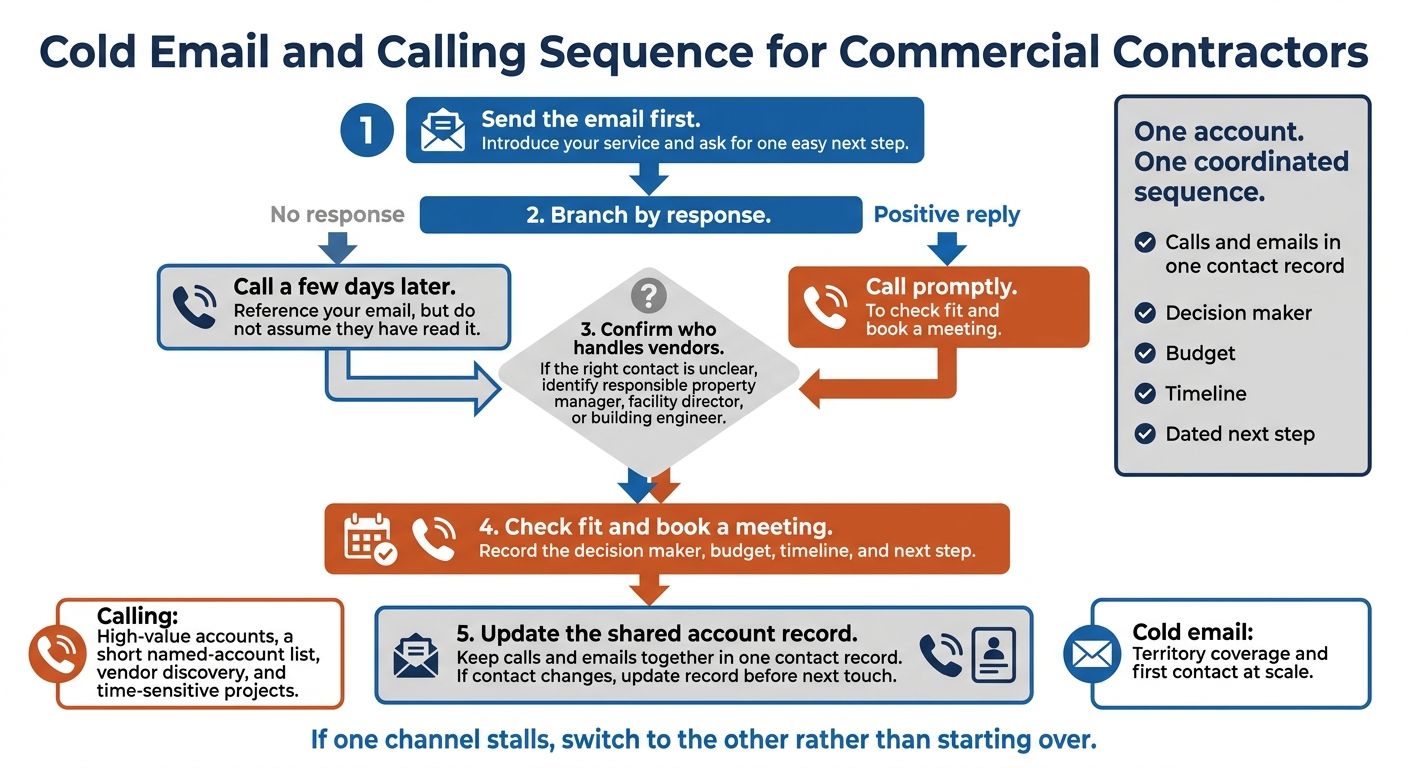
Once you know who handles vendors, choose the channel that gets you to that person fastest. Use this comparison to decide how to start the conversation and follow up.
| Factor | Cold calling | Cold email |
|---|---|---|
| Accounts reached per week | Limited by your caller’s available hours | Covers more territory, but only if deliverability holds |
| Time to first conversation | Immediate when someone answers | Replies may take hours or days |
| Work per conversation | Dialing, gatekeepers, voicemail, and handling objections live | Contact research, message preparation, delivery checks, and handling replies |
| Ease of scaling | Requires more trained callers and supervision | Requires protected sending domains and inboxes |
| Decision maker experience | An interruption that may prompt immediate questions | A message they can review later and forward internally |
| Best use | High-value properties, a short named-account list, vendor discovery, and time-sensitive projects | Territory coverage and first contact at scale |
Choose Calling for Priority Accounts and Email for Territory Coverage
Focus calls on high-value accounts, a short named-account list, vendor discovery, and time-sensitive projects. Prioritize the property managers, facility directors, and building engineers responsible for those accounts.
Use cold email to introduce your service across a territory or reach managers who ignore unknown numbers. An email they can forward also helps when your first contact needs to bring in a facility director or another purchasing stakeholder.
If one channel stalls, switch to the other rather than starting over.
Combine Email and Calls in One Sequence
Keep calls and emails in one coordinated sequence for each account.
Send the email first, then call to move the conversation forward. As a starting point, call nonresponders a few days later. Reference your message, but don’t assume they’ve read it. If you’re unsure who handles vendors, use the call to confirm the right property manager, facility director, or building engineer before continuing outreach.
After a positive reply, call promptly to check fit and book a meeting. Record the decision maker, budget, timeline, and next step. Keep calls and emails in one contact record, and update it before the next touch if the contact changes.
What Our Email Data Shows
This article is published by The Headline Theory, which runs both cold email and cold calling for commercial service companies. Across more than 2 million emails sent for commercial service companies, its campaigns produced 2,700+ interested replies and 500 booked commercial meetings:
- The median time from the first email to the first booked meeting is 3 days.
- Emails sent to the named decision maker drew about twice as many interested replies per contact as emails sent to a general contact.
- About 70% of interested replies came from the first email in a sequence, so the first message carries most of the weight.
That's why the sequence above starts with a researched email to a named person, and uses calls to confirm the right contact and to book the meeting once someone replies.
Once the sequence is set, track replies, meetings, and signed contracts.
Measure Meetings and Signed Contracts
Track Replies, Connections, and Contract Costs
After the sequence runs, measure outcomes - not just activity.
Calculate email reply rate as replies ÷ delivered emails, and phone connect rate as live connections ÷ total attempts. Track interested replies separately from rejections, and decision-maker connections separately from gatekeeper conversations. Neither replies nor connections alone prove revenue.
Follow each account from interested response to booked meeting, qualified meeting, and signed contract. A meeting counts as qualified only when the decision maker attends and budget and timeline are established.
Record email and calling results separately. If both channels help close a deal, count the signed contract only once. Calculate cost per signed contract as total outreach and sales-development costs ÷ signed contracts. Include staff time, tools, infrastructure, and agency fees.
Check Meeting Quality: Clear Heating & Air
Meeting quality matters more than meeting count.
San Diego’s Clear Heating & Air previously used a pay-per-meeting service where three of five meetings lacked a decision maker. With The Headline Theory, it closed $40,000 in new commercial jobs and built $150,000 in pipeline.
The Headline Theory qualifies every meeting for decision maker, budget, and timeline before it reaches the client’s sales team, and works with one company per service in each service area. See more client results.
Decide Who Handles Outreach and Sales Handoffs
Keep outreach in-house if your team has the staff and time for research, calling, email, and follow-up. An outsourced SDR team that runs both calls and email can handle those tasks, but you still need to define who owns qualification and follow-up. Compare hiring a sales rep with using a lead generation agency against what your team can actually handle.
Whether you use calling, email, or both, require every handoff to include the contact’s authority, budget, timeline, service needs, and agreed next step. Then assign someone to follow up.
Conclusion: Match Your Channels to Your Accounts
Let the numbers you track guide your channel budget. Use calling for high-value named accounts and live questions, and email for first contact across your territory.
Before you scale, narrow your target list by service area, building type, and service need. Assign one owner, and reinvest only when qualified meetings and cost per signed contract improve.
Check the rules for each channel before you launch or expand.
Check B2B Calling and Email Rules
FTC CAN-SPAM rules apply to commercial email, with no B2B exception. Use accurate subject lines, include a valid postal address and a clear opt-out, and honor opt-outs within 10 business days.
For commercial calls, follow the Telemarketing Sales Rule and other applicable federal and state requirements. Review your obligations before you launch. This is general information, not legal advice.
FAQs
How long should you test each outreach channel?
Set a fixed test period and success criteria in writing before you start, and run both channels against the same target list. The Headline Theory reports a median of 3 days from the first email to the first booked meeting, but a fast first meeting isn't the whole picture.
To assess your results, track email reply rates, phone connect rates, interested replies, booked meetings, qualified meetings, and cost per signed contract. Don’t judge performance only by how fast you book the first meeting.
When should you stop following up with a property manager?
Stop when they ask you to, and log it. Honor every email opt-out (CAN-SPAM requires it within 10 business days) and every request not to be called.
Otherwise, a finished sequence isn't a dead account. If a property manager hasn't replied, call to check that you have the right contact. If the timing is wrong, ask when the current contract renews, note that date in your CRM, and come back before that window.
How should you time outreach around vendor contract renewals?
Start with a personalized email. If you don’t get a reply, follow up by phone to confirm who handles vendors and when the contract is up for renewal. Record the renewal date and plan to reach out well before the vendor review starts, not when the contract is about to end.
If you get a positive email reply, call promptly to book a meeting and confirm the decision maker, budget, and timeline.
Related posts
One company per service area. See if yours is still open.