Lead Generation Agency vs Hiring a Sales Rep for Commercial Contractors
· 8 min read

Choose based on what your sales process needs - not the retainer or salary alone. Use an agency for more meetings, hire a rep for direct sales control, or pair agency outreach with an in-house closer. Compare all three using total cost per signed contract, including your time spent closing.
- Agency: Outsourced prospecting with less daily staff management. Your team still handles estimates, proposals, and closing.
- Sales rep: Direct control and deeper customer relationships, but you pay for recruiting, coaching, benefits, commissions, and ramp-up.
- Hybrid: Agency-booked meetings with in-house closing. Count both costs.
This article is published by The Headline Theory, a lead generation agency. For timing, it reports a median of 16 days from contract signing to the first booked meeting. A new rep has to be recruited and trained before outreach even starts. These are past results, not guarantees.
Quick Comparison
| Factor | Agency | In-house rep | Hybrid |
|---|---|---|---|
| Cost | Retainer plus internal closing | Fully loaded hiring and employment costs | Agency plus closer |
| Management | Review targeting and meeting quality | Recruit, train, and coach | Manage handoffs and follow-up |
| Control | Set scope and messaging | Direct daily work | Split outreach and closing |
| Ownership and turnover | Put access and exit terms in writing | Keep records in company accounts | Keep shared records in your CRM |
| Scaling | Change contracted scope | Hire and train | Match outreach to closing capacity |
The final check: who owns the data, who follows up, and how much gross profit remains after sales costs? Those answers matter more than the lowest monthly price.
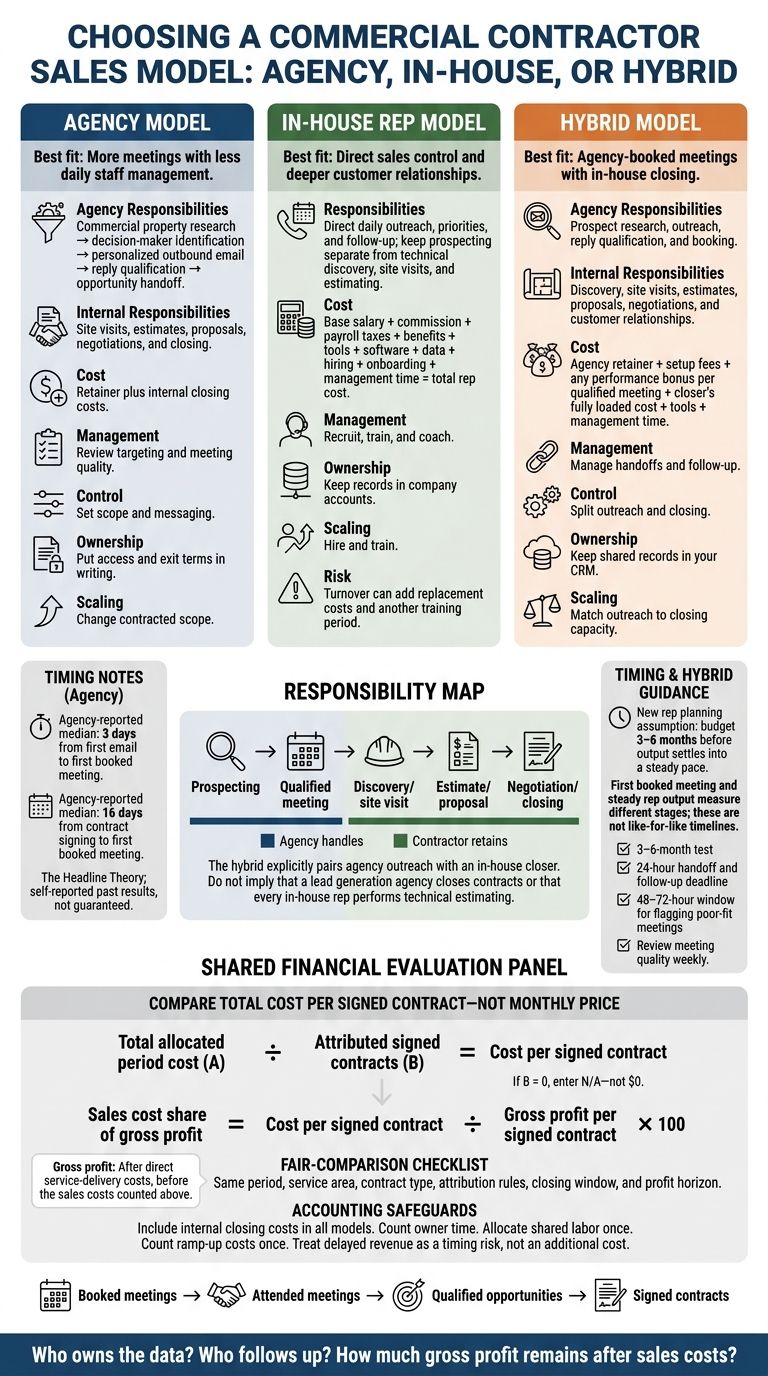
Agency vs Sales Rep vs Hybrid: Commercial Contractor Sales
Lead Generation Agency: Costs, Timing, and Ownership
What Your Retainer Covers
Take The Headline Theory as an example. Its service includes commercial property research, decision-maker identification, cold email sent from your company's name, one-to-one cold calls from its SDR team, reply qualification, and meeting handoff. It can also work your old quotes and past customers. Because the agency calls as well as emails, you get phone outreach without hiring someone to make the calls.
Your team still handles site visits, estimates, proposals, negotiations, and closing. Compare the retainer plus your internal labor costs with a rep’s fully loaded cost - not just their salary.
Confirm every deliverable in your agreement, and put the definition of a qualified meeting in writing. Ask whether onboarding, data, or CRM access costs extra. Check how soon the agency can book meetings and who controls the data.
Time to Your First Booked Meeting
The agency reports a median of 3 days from first email to first booked meeting and 16 days from contract signing to first booked meeting. It has booked 500 commercial meetings since November 2025 and generated more than $10 million in pipeline for 50+ commercial service companies (see client results).
Client example: Mighty Oak Landscaping in Suwanee, GA, got 14 appointments in 10 weeks and closed 7 of them for $200,000 in annual recurring revenue.
Use those figures to assess whether the timing fits your pipeline needs. They reflect past results, not a guarantee.
Who Owns Your Lists, Mailboxes, and Conversations?
Before signing, get written terms covering list access and export rights, control of outreach domains and mailboxes, and access to reply history. Specify what transfers when the service ends and who will hand active conversations over to your team.
Keep contact records, meeting notes, and next steps in your CRM. A calendar invitation shouldn’t be your only record of an opportunity.
The agency offers exclusivity for one client per service area. Your agreement should define the covered service and geographic boundaries, whether prospects can be shared, and your right to continue active conversations after the contract ends. If you want direct control over outreach and follow-up, the next comparison is the full cost of hiring a rep.
In-House Sales Rep: Costs, Management, and Turnover
An in-house rep gives you direct control over outreach, priorities, and follow-up. But recruiting, coaching, performance management, and replacement are also your responsibility. If you want more control without the risk of added headcount, compare the full cost of a hire with the agency model above.
Add Up Your Rep’s Full Cost and Ramp-Up
Use the same time period as your agency quote and add up the full expense:
Base salary + commission + payroll taxes + benefits + tools + software + data + hiring + onboarding + management time = total rep cost.
Before prospecting begins, your rep needs a defined territory, prospect data, working tools, service training, and an outreach plan. Count ramp-up time only once, under hiring and training costs, and budget for a ramp-up period before output settles into a steady pace. Treat delayed revenue as a timing risk - not another cost to add to the total.
That investment makes sense only if there’s enough work to keep the rep busy.
When Hiring a Rep Makes Sense
An internal hire works best when you have steady opportunity volume, a clear territory and offer, reliable CRM processes, and the capacity to fulfill new contracts. It also suits a long, relationship-driven sales cycle, provided a manager has time to coach the rep.
Keep prospecting separate from technical discovery, site visits, and estimating so those tasks don’t squeeze out outreach. Tie compensation to profitable, collected revenue, and put the rules for earning and paying commissions in writing.
Protect Your Pipeline When a Rep Leaves
Your manager needs visibility into active opportunities before anyone leaves. Each opportunity should document its decision-makers, scope, proposal status, last contact, and dated next action.
When a rep leaves, secure access, reassign accounts and scheduled follow-ups, and introduce active prospects to their replacement contact. While you recruit, review stalled opportunities. Even with complete records, replacement costs and another training period can slow sales momentum. Keep every active opportunity ready for handoff so turnover doesn’t interrupt follow-up.
If you want outsourced prospecting with in-house closing, the next section covers the hybrid model.
Hybrid Model: Agency Outreach, In-House Closing
A hybrid model can help if you can close commercial work but need a steadier flow of opportunities without hiring a full-time salesperson. The agency handles prospect research, outreach by email and phone, reply qualification, and booking. Your team keeps discovery, site visits, estimates, proposals, negotiations, and customer relationships in-house. A fixed test period lets you check your target accounts and messaging before hiring.
Set Meeting Handoff and Follow-Up Rules
Write down what qualifies a meeting: the service needed, property location, contact’s buying role, and genuine interest. When booking, the agency should enter contact details, replies, and qualification notes into your CRM. Name the person responsible for closing and set a 24-hour handoff and follow-up deadline. Your team handles preparation and follow-up after discovery.
Decide who handles confirmations, rescheduling, and no-show follow-up. Set a 48–72-hour window for flagging poor-fit meetings, and spell out any replacement or credit terms. Document service-area and territory exclusivity, too. The contract should state that you own the sending domains, mailboxes, lists, and CRM records. Review meeting quality with the agency each week.
Include Both Agency and Closing Costs
The retainer is only part of the bill. Add setup fees, any performance bonus per qualified meeting, your closer’s fully loaded cost, tools, and management time. Account for closing time spent on discovery, travel, site visits, estimating, proposals, and follow-up. If you close deals yourself, count your time - it isn’t free.
Compare the hybrid model with a sales rep over the same period, using the same cost categories and allocation rules. Track booked meetings, attended meetings, qualified opportunities, and signed contracts separately. Use those figures for the final cost-per-contract comparison.
Conclusion: Compare Cost per Signed Contract
An agency adds prospecting capacity. An in-house rep gives you control and deeper relationships. A hybrid splits the work. To compare them on equal terms, calculate total cost per signed contract using the table below.
Fill In Your Costs and Signed Contracts
Enter the costs that apply to each model, then divide by its signed contracts. Use the same period, service area, contract type, attribution rules, and closing window for every model.
Include internal closing costs in all three models. Allocate shared labor only once, and add ramp-up costs only if you haven’t counted them elsewhere.
| Period cost or result | Agency | In-house rep | Hybrid |
|---|---|---|---|
| Salary or retainer | $___ | $___ | $___ |
| Commissions | $___ | $___ | $___ |
| Payroll taxes | $___ | $___ | $___ |
| Benefits | $___ | $___ | $___ |
| Recruiting and onboarding/setup | $___ | $___ | $___ |
| Tools and data | $___ | $___ | $___ |
| Management or closer allocation | $___ | $___ | $___ |
| Incremental ramp-up cost | $___ | $___ | $___ |
| Total allocated period cost (A) | $___ | $___ | $___ |
| Attributed signed contracts (B) | ___ | ___ | ___ |
| Cost per signed contract (A ÷ B) | $___ | $___ | $___ |
If B is zero, enter “N/A” - not $0 - for cost per signed contract. Track open opportunities separately until they close.
Next, compare each model’s cost per signed contract with the gross profit that contract produces.
Compare Sales Cost With Contract Profit
Enter gross profit per signed contract after direct service-delivery costs but before the sales costs counted above. For recurring work, use the same profit horizon across all models.
Calculate sales cost share of gross profit = cost per signed contract ÷ gross profit per signed contract × 100.
Read those results alongside management capacity, ownership terms, and turnover risk. Fill in the figures below to see which model has the lowest sales cost per dollar of gross profit.
Agency = $__ per signed contract ÷ $__ gross profit × 100; Rep = $__ ÷ $__ × 100; Hybrid = $__ ÷ $__ × 100.
FAQs
How many meetings justify hiring a sales rep?
Hiring an in-house sales rep makes sense when you have steady, year-round meetings, a repeatable sales process, and an owner or manager who has time to coach them. A full meeting calendar alone doesn’t justify the hire.
If meeting volume is uneven or management time is limited, an agency may be a lower-risk option.
How should you compare costs before deals close?
Compare your sales rep’s full annual cost with the agency’s annual retainer. For the rep, count base salary, commission, payroll taxes, benefits, tools, data, recruiting, ramp-up time, and turnover costs. Use your own estimates until deals close.
Calculate the cost for each option using the same formula:
Total annual investment ÷ estimated signed contracts = estimated cost per signed contract.
Can agency outreach work for seasonal services?
Yes. Agency outreach can help you generate leads for seasonal services like landscaping, HVAC, plumbing, or snow removal - without paying a full-time sales salary during slower months. You can keep outreach running during peak periods, then scale back or pause when the season ends, depending on your agency agreement.
To see how calling works alongside email, read about cold calling for commercial service companies.
Related posts
One company per service area. See if yours is still open.