How Landscapers Win Multi-Property Contracts With Property Management Companies
· 8 min read

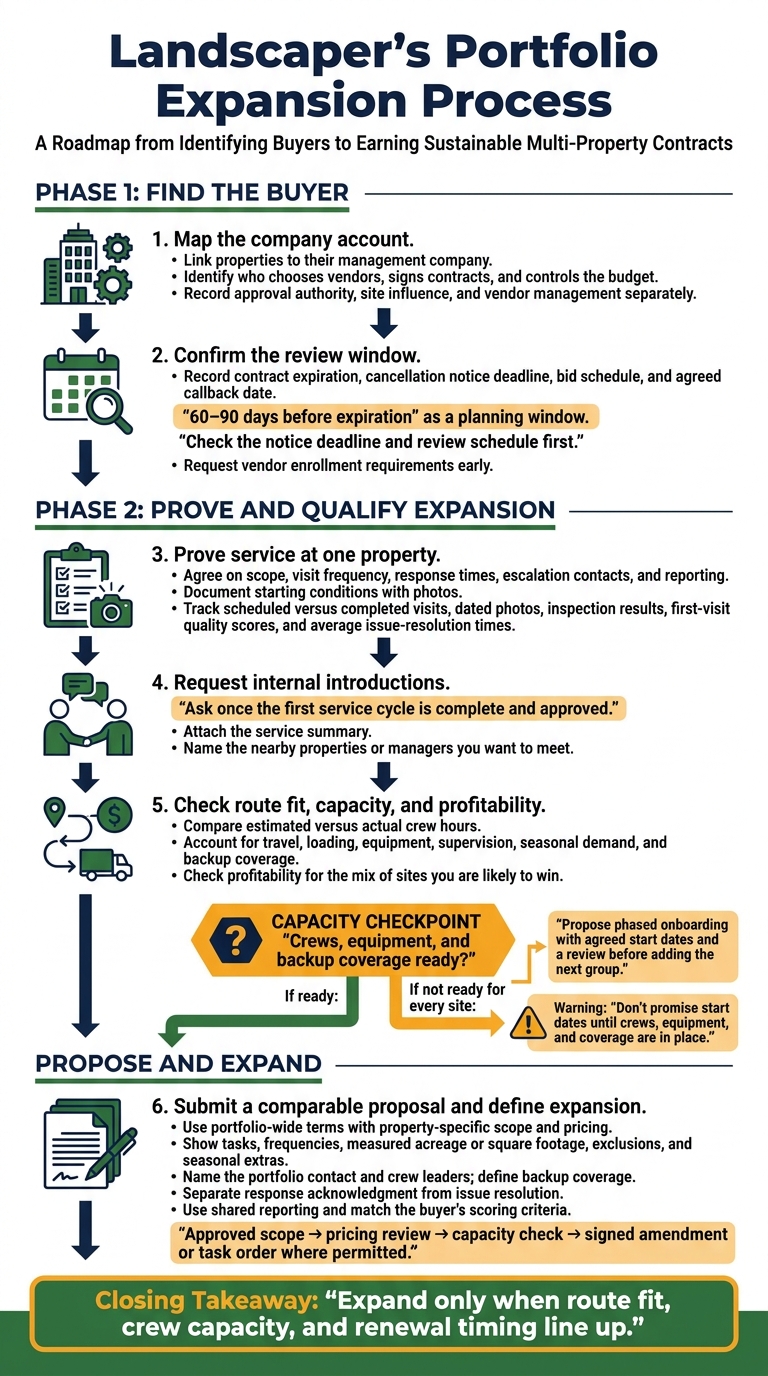
Winning multi-property landscaping contracts starts with finding who can approve the work - not just who manages each site. Confirm the buyer’s contract review dates, prove service at one property, and use those results to ask for introductions across the company.
The path to a portfolio award comes down to three steps:
- Reach the right buyer before renewal. Start before the contract's notice deadline and bid schedule, not just before expiration.
- Show results before expanding. Track completed visits, site photos, and issue-resolution times. Check crew hours, travel, equipment, and backup coverage before adding sites.
- Make the proposal easy to compare. Provide site-by-site scope and pricing, clear response commitments, shared reporting, and terms for adding properties.
The goal isn’t simply more properties. It’s a group of sites the landscaper can serve well without cutting into profits.
1. Find the Portfolio Buyer and Contract Review Dates
Map Properties to Vendor Decision Makers
Build your prospect list around company accounts, not individual addresses. Use company websites, property pages, county records, vendor portals, and RFP notices to connect each site to its company. Then confirm those links with a contact. The goal is to find one company-level buyer rather than treat every property as a separate sale.
Keep approval authority, site influence, and vendor management in separate fields so you can reach the right person later. Ask your site contact to introduce you to whoever handles multiple properties.
Create one account record for the company, with each property and decision maker tagged beneath it. Once you understand the company structure, add a renewal timeline for each property.
Time Outreach Around Vendor Reviews
Under each company account, record every site’s current landscaper, contract status, expiration date, cancellation notice deadline, bid schedule, service needs, and agreed callback date. Ask when the review starts - not just when the contract expires. Portfolio buyers may review several sites on the same cycle. Request vendor enrollment requirements early, too.
Work back from the notice deadline, not the expiration date. Buyers may need time for budgeting, site walks, bidding, and onboarding. If a property is already under contract, ask permission to reconnect before its next review and schedule that callback. Without the notice deadline, a renewal date could lead you to contact the buyer after the decision has effectively been made.
Use the decision maker and review timing to choose which accounts to contact first.
Use Outreach Results to Guide Your Prospecting
Put contact research ahead of sending every message to a general property inbox. This article is published by The Headline Theory, which runs cold email and cold calling for commercial landscapers. Its commercial landscaping email campaigns produced 1,808 interested replies and 378 booked meetings with commercial decision makers. Emails sent to the named decision maker drew about twice as many interested replies per contact.
Keep agreed renewal callbacks on your outreach calendar. During the first four weeks of its cold calling program, October–November 2026, apartment and condo communities answered and spoke with landscapers at a rate of 33%, compared with 19% for other commercial property types (n = 1,086 dials).
In that same window, 4% of live conversations involved properties already under contract, which were logged for callback (n = 296 conversations). These figures are not portfolio conversion rates or guarantees of results.
2. Prove Your Service Before Adding Properties
Track Results at Your First Property
Build a track record at one property before asking for more. Use those results to make the case for serving the rest of the portfolio.
Before work begins, agree on the scope, visit frequency, response times, escalation contacts, and reporting schedule. Photograph dead plants, broken irrigation heads, and drainage problems to document the site’s starting condition. Make clear which problems you inherited and which work you’re responsible for completing.
Keep a short service summary with scheduled versus completed visits, dated photos, inspection results, first-visit quality scores, and average issue-resolution times. Attach technician notes. Use the same inspection standard each month so the property manager can forward the record to regional leadership without rewriting it.
Ask for Introductions Within the Management Company
Let the first site’s results support your request for internal introductions. Ask once the first service cycle is complete and approved. Name the nearby properties or managers you’d like to meet and attach your service summary. Explain how a single contact, consistent standards, and consolidated reporting can reduce their oversight work.
The Headline Theory’s client Lightning Lawn Care in Orlando, Florida, won nine KinderCare properties on 12-month commercial contracts.
Check Crew Capacity and Route Coverage
Before taking on more properties, confirm that your team can handle the added work without letting service slip.
Map proposed sites against your current routes. Each week, compare estimated crew hours with actual hours, accounting for travel, loading, equipment needs, supervision, seasonal demand, and backup coverage. Separate capacity you have now from capacity that requires hiring or equipment purchases. Don’t promise start dates until crews, equipment, and coverage are in place.
Check profitability for the mix of sites you’re likely to win - not the entire portfolio. An isolated property may need different pricing than nearby stops. If launching every site at once would strain service, propose phased onboarding with agreed start dates and a review before adding the next group.
| Operating approach | Benefit | Tradeoff | Mitigation |
|---|---|---|---|
| Dense routes | Less travel between stops | Risk of relying too heavily on one micro-market | Serve different property types within the cluster |
| Scattered sites | Greater geographic coverage | More paid travel and harder backup coverage | Include travel in pricing and assign backup crews |
| Phased onboarding | Time to test service and reporting | Slower rollout | Agree on stages and review performance before expanding |
3. Build a Multi-Property Proposal Buyers Can Compare
Once you’ve proved your service at one site, turn that proof into a proposal buyers can score across their portfolio.
Use a Shared Scope With Site-by-Site Pricing
Follow the buyer’s MSA structure: put portfolio-wide terms in one agreement, then attach property addenda with each site’s scope and pricing. Keep the format consistent while allowing tasks, frequencies, and access rules to vary by property type.
Build pricing around a scope matrix that lists tasks, frequencies, standards or methods, and who does the work. Use measured acreage or square footage - not estimates based on guesswork. Show prices by site and service line so buyers can compare individual properties and the portfolio total.
If your pricing depends on sites being close together, make that clear. Tight route coverage can help you offer more competitive rates.
| Pricing schedule field | What to include |
|---|---|
| Property | Address, building or area identifiers, and maintained acreage or square footage |
| Included work | Tasks, quantities, and frequency by season |
| Access | Work hours, gates, parking, and resident notices |
| Sign-off | Who checks the work and which record closes the visit |
| Exclusions | Repairs, extra materials, and work outside the base scope |
| Monthly investment | Your quoted monthly amount for that property |
| Seasonal extras | Separate quotes, approval requirements, and pricing methods for seasonal or optional work |
Set Staffing, Response, and Reporting Commitments
Next, show how you’ll deliver consistent service at every site.
Name one portfolio contact and the assigned crew leaders. Spell out crew coverage, backup coverage, and response-time commitments. Separate acknowledgment from resolution: explain when you’ll reply to routine requests, assess irrigation issues, respond to hazards, report storm delays, and reschedule missed visits. Commit only to deadlines you can meet.
Use the same report format for every site, covering service dates, completed tasks, photos, open issues, corrective actions, and escalation status. Match invoice coding to the buyer’s property records. Where required, attach insurance, licensing, and vendor-compliance documents, including applicable state-specific irrigation or pesticide licenses.
Match the Buyer’s Scoring Criteria and Define Expansion Terms
Buyers compare more than price. Match their scoring sheet line by line, following their evaluation order and stated weights rather than creating your own. Make scope, price, communication, experience, irrigation and plant health, references, and reputation easy to find.
Define which sites and services the initial award covers. Then explain how buyers can add sites: an approved scope, pricing review, capacity check, and signed amendment or task order where permitted.
Conclusion: Choose Your Next Portfolio Target
Once you understand the buyer structure, pick an account that fits your routes and capacity. Start with one management company and one reachable cluster of sites - the closest, most tightly grouped properties you can serve now.
Confirm who chooses vendors, who signs, who controls the budget, and when the next renewal or bid review opens. Focus on a decision maker you can reach who has a review window coming up.
Use that window to turn results at one property into work at the next. Ask for an introduction to a named contact based on your first-site results, then share site-by-site pricing before requesting a portfolio award. Expand only when route fit, crew capacity, and renewal timing line up and you can keep service at the same standard.
FAQs
Does approved vendor status guarantee access to portfolio bids?
No. Approved vendor status means you’re generally eligible for consideration - not guaranteed an invitation to bid or a contract. Property managers still weigh responsiveness, reliability, risk reduction, and contract renewal timing when choosing vendors. A regional property manager or facilities director, rather than a single-site manager, may make decisions for the portfolio.
To win, you need to make the shortlist before bidding starts and meet standardized scope and service expectations across sites.
How can you protect margins if only some sites are awarded?
Price each property based on the awarded cluster’s route density, travel, and administrative costs - not the savings you expect from winning the full portfolio. Use property-level addenda to make clear that each price applies only to that cluster.
Keep your promised service levels and reporting consistent. Explain that portfolio discounts depend on route density, and offer tiered rates that drop as more sites are added.
How can you limit reliance on one portfolio client?
Balance your portfolio accounts with work from direct commercial owners, HOAs, and municipal contracts. Keep properties clustered geographically so you can add or shift work efficiently while keeping service reliable.
For large portfolios or those spread across multiple areas, focus on consistent service documentation and reporting - not on serving every location yourself. Keep work within your best service radius, and decline or hand off sites outside it.
Related posts
One company per service area. See if yours is still open.