How Plumbing Companies Become Approved Vendors for Property Management Companies
· 6 min read

Plumbing companies become approved vendors by contacting the person who handles enrollment, submitting the required paperwork, and confirming approval before accepting work. The starting documents usually include a W-9, proof of insurance, and required licenses.
Approval gets a company on the list - not a guaranteed work order. Getting repeat work also takes:
- The right contacts: Reach managers directly or through local property-management associations.
- Clear service terms: Confirm rates, response times, spending limits, and property-access rules.
- Reliable job records: Provide updates, photos, and accurate invoices.
- Account tracking: Track approval, first jobs, and recurring agreements separately, and keep documents current.
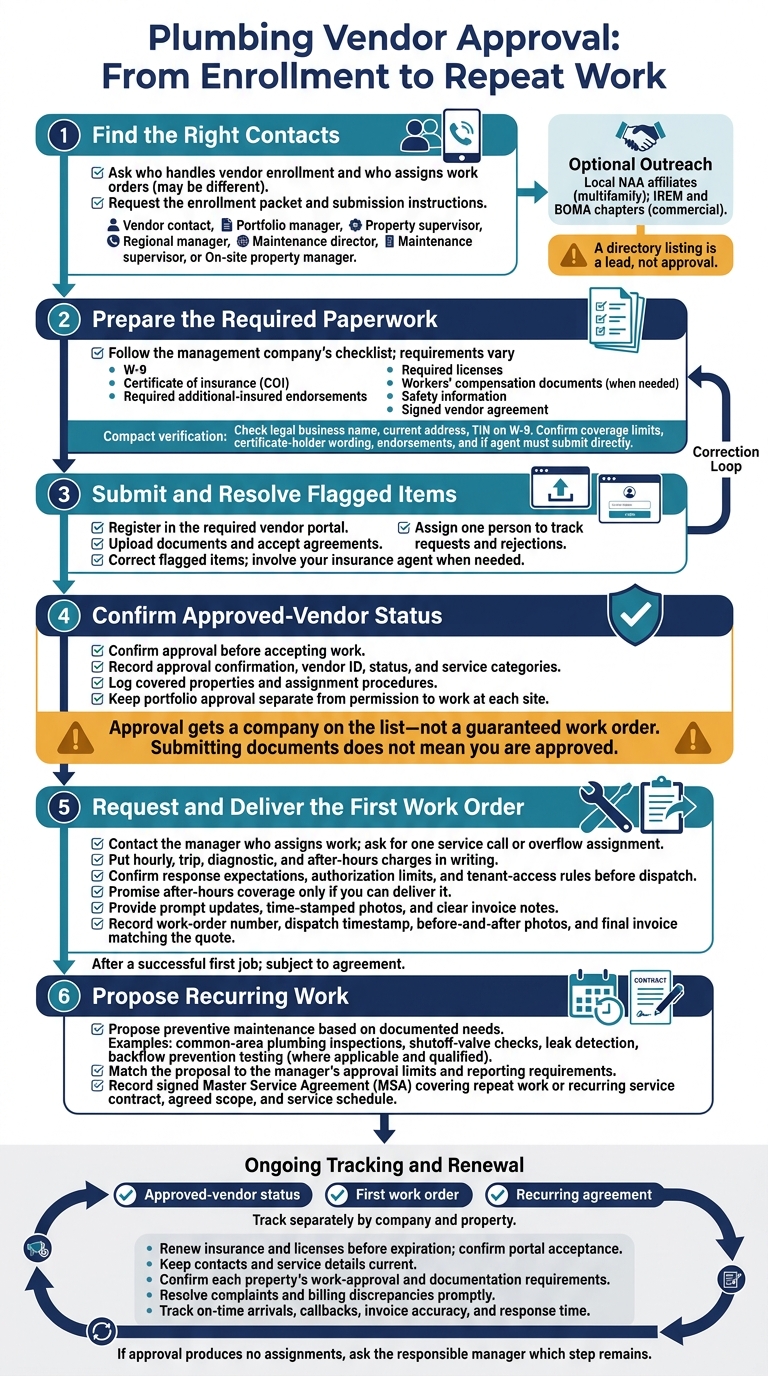
Plumbing Vendor Approval: From Enrollment to Repeat Work
Submit Your Vendor Documents and Complete Enrollment
Before sending documents, confirm who handles vendor approval. Ask that company’s vendor contact, portfolio manager, or property supervisor for the enrollment packet and submission instructions. Requirements vary by management company, property owner, state, and scope of work, so follow the company’s checklist.
Gather Your Required Documents
Store your paperwork in a secure digital folder. Include your W-9, certificate of insurance (COI), required additional-insured endorsements, licenses, workers’ compensation documents when needed, safety information, and signed vendor agreement. Check that your W-9 lists your legal business name, current address, and taxpayer identification number.
Many packets require you to list the management company - and sometimes the property owner - as additional insured. Confirm coverage limits with the management company. Then check the exact certificate-holder wording and required endorsements with your insurance agent before submitting. Also ask whether your agent must send the documents directly.
Complete the Required Vendor Portal Setup
Once your paperwork is ready, follow the instructions for vendor portal registration, document uploads, and agreement acceptance. Put one person in charge of tracking requests and rejections.
Submitting documents does not mean you are approved. Address flagged items, bring in your insurance agent if coverage documents need corrections, and confirm your status with the management company before accepting work. After approval, contact the manager who assigns the first work order.
Contact the Right Manager and Get Your First Work Order
After onboarding, connect with the person who assigns work orders. Start by asking for one service call or overflow assignment.
Reach the Decision-Maker by Name
Check property websites, staff pages, and association directories such as BOMA, IREM, and NAA. Look for the regional manager, maintenance director, maintenance supervisor, or on-site property manager. Ask the receptionist or office staff who handles plumbing vendor approval and emergency dispatch.
Address that person by name. Keep your introduction short: state your trade, service area, and hours, and mention that your W-9, COI, and licenses are ready. Then explain which jobs you can handle and how soon you can respond.
This article is published by The Headline Theory, which runs cold email and cold calling to property managers for commercial service companies, including plumbing. In its plumbing cold email campaigns, 46% of replies said the email had reached the wrong person (980 replies, Jul – Nov 2026). On the phone, half of live conversations with commercial properties reached a gatekeeper rather than the decision maker (n = 694 conversations, Oct 9 – Nov 19, 2026). Getting the right name first saves most of the wasted effort.
Offer Emergency Coverage, Fast Response, and Clear Rates
Promise after-hours coverage only if you can deliver it. Explain how emergency calls reach your team. Put your hourly, trip, diagnostic, and after-hours charges in writing. Before dispatching, confirm authorization limits and tenant-access rules.
Send prompt updates during the job. Afterward, provide time-stamped photos and plain-language invoice notes so the manager can explain the work to the owner.
Turn Your First Job Into a Service Agreement
After a successful first work order, use your findings to propose a preventive-maintenance agreement. Base the scope on documented needs, such as common-area plumbing inspections, shutoff-valve checks, leak detection, or backflow prevention testing where applicable and within your qualifications.
Match the proposal to the manager’s approval limits and reporting requirements. For broader negotiations, see getting commercial plumbing contracts.
Meet Managers Through Local Associations
If direct outreach is slow, local apartment and property-management associations can help you meet managers who influence vendor approval. These managers can also point you to the right vendor contact. Choose chapters whose members manage properties in your service area.
For multifamily properties, connect with local NAA affiliates. For commercial portfolios, use IREM and BOMA chapters.
At educational events, introduce yourself to managers and maintenance supervisors. Ask who handles vendor onboarding and which manager approves new plumbing vendors.
When you follow up, address the person by name and mention where you met. Ask for the onboarding packet or a direct introduction to the vendor contact. A directory listing is a lead, not approval. Record the company, property, and contact’s role so you can follow up later.
Don't overlook builders. In The Headline Theory's plumbing campaigns, general contractors and builders replied interested about 1 in 55 times, against about 1 in 900 for industrial and warehouse properties, and produced two-thirds of all interested replies (22,000+ contacts, Jul – Nov 2026). Builders who hire plumbing subcontractors can introduce you to the owners and managers of the buildings they deliver.
Track Vendor Approval, First Jobs, and Recurring Agreements
After onboarding and your first assignment, check whether the account is moving toward repeat work. Track approved-vendor status, first work orders, and recurring agreements separately for each company and property.
Record Progress by Company and Property
Use one spreadsheet or CRM with linked company and property records. Track vendor packets, submissions, contacts, and insurance and license expiration dates. Keep portfolio approval separate from permission to work at each site, and note who assigns work at each property.
| Milestone | Evidence to record | Next action |
|---|---|---|
| Approved-vendor status | Approval confirmation, vendor ID, approved status in the portal, and approved service categories | Log covered properties and assignment procedures. |
| First work order | Work-order number, dispatch timestamp, before-and-after photos, and the final invoice matching the quote | Record the outcome and schedule the next follow-up. |
| Recurring agreement | Signed Master Service Agreement (MSA) covering repeat work or a recurring service contract | Record the agreed scope and service schedule. |
Track on-time arrivals, callbacks, invoice accuracy, and response time to spot where progress stalls.
Keep Your Vendor Approval Active
Keep a compliance checklist with each account:
- Renew insurance and licenses before they expire, and confirm acceptance in the required portal.
- Keep account contacts and service details current.
- Confirm each property's requirements for work approval and documentation.
- Address service complaints and billing discrepancies promptly.
If approval hasn't led to assignments, ask the responsible manager which step you need to complete next. Don't assume approval puts you in the work-order rotation.
FAQs
How long does plumbing vendor approval take?
Approval timing depends on how soon you submit your paperwork and your insurance agent completes any required updates. In one property management onboarding example, approval takes 3 days to 3 weeks, depending on how promptly the vendor and insurance agent respond.
Ask the property manager for the onboarding packet and expected timeline so you can finish the required compliance steps before work starts.
What should you do if vendor approval stalls?
Confirm that your contact has all required paperwork, including your insurance certificate and W-9. Follow up with the manager who requested your services. They may need to route your file through an internal help desk or a third-party compliance platform.
Ask whether your insurance agent should submit the certificate directly to the company or portal. Some compliance platforms only accept certificates sent by the agent.
Can you negotiate a property manager’s vendor agreement?
Yes, but only within the property manager’s approval limits. You can negotiate the scope, pricing, response times, and agreement terms. Compliance requirements, though, may be fixed, and approval may need to follow a portfolio or maintenance process.
Ask for the vendor packet covering your W-9, insurance, licenses, safety information, and signed agreement. You may also need to name the management company as an additional insured.
Related posts
One company per service area. See if yours is still open.