What 2,700+ Cold Calls to Commercial Properties Taught Us
· 8 min read
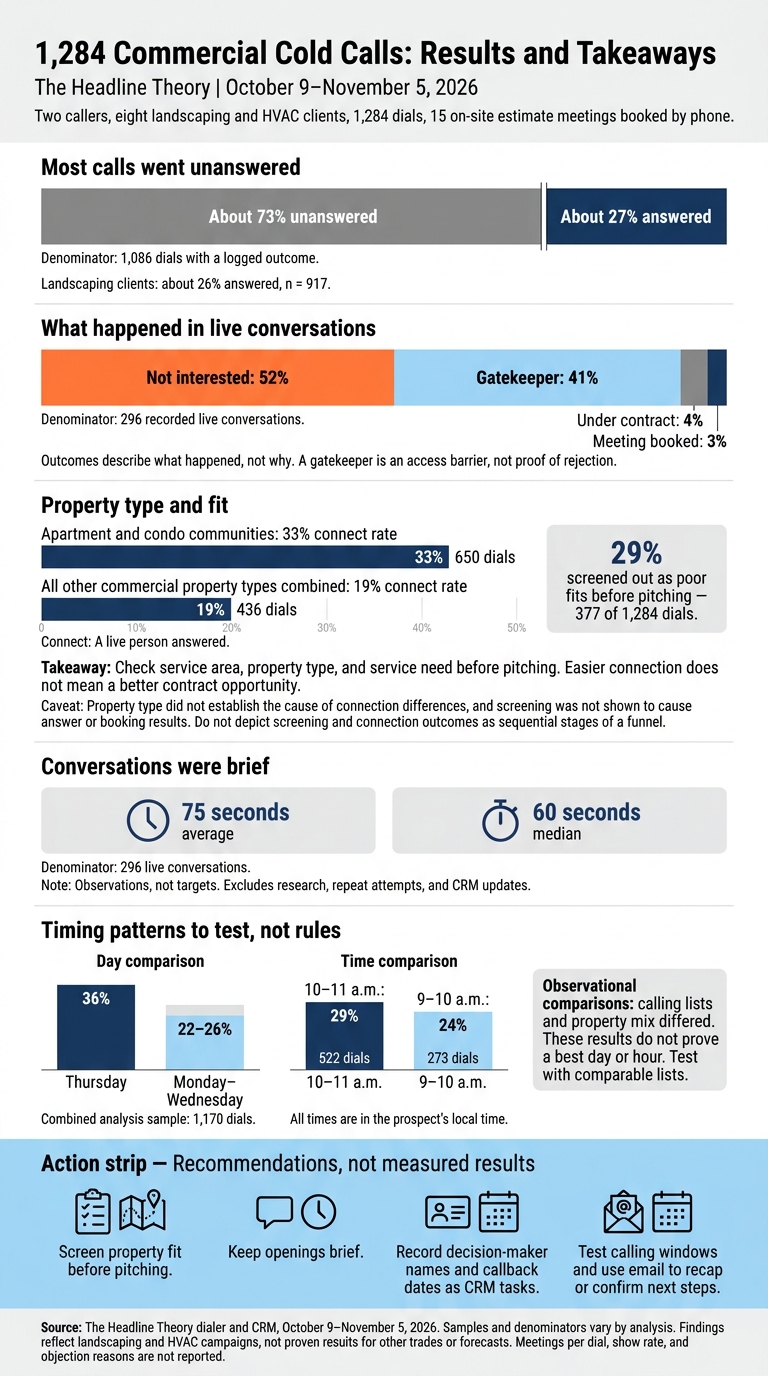
Our callers booked about one on-site meeting for every 70 cold calls to commercial properties, and 89% of those meetings came from the very first call to the property. A live person picked up on about 27% of dials, and half of those conversations reached a gatekeeper rather than the decision maker. The takeaway: screen properties before pitching, call apartment communities and late mornings first, and get the decision maker's name on every call.
This report is published by The Headline Theory, which runs cold calling and cold email for commercial service companies. From October 9 to November 19, 2026, its three callers made 2,700+ dials to 2,500+ commercial properties for 15 landscaping and HVAC clients, booking 39 on-site estimate meetings by phone for 12 of those 15 clients. The data showed:
- Meetings per dial: about 1 meeting per 70 dials overall, about 1 per 60 for landscaping clients, and about 1 per 50 when calling apartment communities.
- Property type mattered: apartment and condo communities picked up and talked on 32% of dials, against 19% for other commercial properties.
- Access was the main hurdle: 49% of the 694 live conversations reached a gatekeeper; 34% ended in "not interested."
- Fit and time needed attention: callers screened out 24% of numbers as poor-fit properties before pitching. Live conversations averaged 86 seconds; calls that booked a meeting lasted about 4 minutes.
- Timing offered test ideas, not rules: 11am to noon and Thursdays had the highest connect rates, and the lunch hour the lowest, but different calling lists could explain part of the gaps.
These findings support testing call windows, checking property fit, and using CRM tasks and email for follow-up. They do not predict results for other trades or prove a best time to call.
How many calls it takes to book a meeting
About 1 meeting per 70 dials
From October 9 to November 19, 2026, callers booked about 1 on-site meeting for every 70 dials (38 meetings from 2,737 dials tied to the dialer). Results differed by segment:
October 9–November 19, 2026; source: our dialer and CRM. A meeting is an on-site estimate meeting logged in the CRM as booked by phone.
| Segment | Meetings per dial | Sample size |
|---|---|---|
| All calls | About 1 per 70 dials | 38 meetings / 2,737 dials |
| Landscaping clients | About 1 per 60 dials | 36 meetings / 2,145 dials |
| Apartment communities | About 1 per 50 dials | 35 meetings / 1,773 dials |
| Live conversations | 5 meetings per 100 conversations | 34 meetings / 694 conversations |
These are meetings booked, not meetings held: show rate isn't recorded yet. HVAC campaigns have booked too few meetings by phone so far to report a separate rate.
Most meetings came from the first call
89% of call-booked meetings came from the first call to that property (34 of 38 meetings). The median time from first dial to booked meeting was the same day, and half of the meetings took place within 3 days of booking (n = 39 meetings).
This figure is partly structural: most properties had been called only once during the window. Don't read it as "never call twice." Read it as: when the right person picks up and the property needs the service, the meeting usually gets booked on that call, so be ready to book on the spot.
How often people answered and what happened next
About 1 in 4 dials reached a live person
From October 9 to November 19, 2026, a live person answered about 27% of dials with a logged outcome (694 of 2,531). Landscaping calls connected at 28% (n = 1,945) and HVAC calls at 24% (n = 586).
Half of live conversations reached a gatekeeper
When someone picked up, the call ended in one of five ways.
Recorded outcomes for October 9–November 19, 2026; n = 694 live conversations. Recommended next steps are not measured results.
| Outcome | Share | Meaning | Recommended next action |
|---|---|---|---|
| Gatekeeper | 49% | Reached a gatekeeper, not the decision maker. | Ask for the decision maker's name and best callback time. |
| Not interested | 34% | Declined the offer. | Log the response and respect the refusal. |
| Under contract | 8% | Has an existing contract. | Log the renewal or callback date in your CRM. |
| Meeting booked | 5% | Booked a meeting during the call. | Confirm the time, address and attendees right away. |
| Follow up later | 3% | Asked to be called back. | Set a dated CRM task, not just a note. |
The outcome tells you what happened, not why. Reaching a gatekeeper tells you about access to the decision maker, not whether that person would accept or decline your offer. The gatekeeper and not-interested shares also depend partly on how each caller logs outcomes.
Next, we look at which property types were most likely to answer.
Property type, fit, and call length
Apartment and condo communities answered more often
October 9–November 19, 2026; source: our dialer and CRM. A connect means a live person answered and talked.
| Property group | Connect rate | Sample size |
|---|---|---|
| Apartment and condo communities | 32% | 1,586 dials |
| All other commercial property types combined | 19% | 945 dials |
Apartment communities also produced most of the meetings: about 1 meeting per 50 dials. Put them first on your calling list, but track fit separately. An easier connection doesn't mean a better contract opportunity. On-site management may make these properties easier to reach, but we didn't test the cause.
Screen out poor-fit properties before pitching
Callers screened out 24% of numbers as poor-fit properties before pitching (651 of 2,737 dials).
Save calling time by checking service area, property type and service need before you pitch. Treat these checks as pre-pitch filters, not measured rejection outcomes.
Live conversations were short; booking calls weren't
Live conversations averaged 86 seconds, with a 66-second median (n = 694 conversations). Calls that booked a meeting lasted about 4 minutes (n = 34 calls).
Keep your opening brief: name your business, state your service, and ask one question about how the property handles that service today. When the conversation runs past the first minute, you're usually in a real discussion, so take the time to confirm the decision maker, the scope and an on-site estimate time.
These call lengths are observations, not targets. They exclude research, repeat attempts and CRM updates.
Next, we looked at which days and hours produced more live answers.
Calling times and limits of the data
The timing data points to possible patterns, but it doesn't prove them.
Thursday had the highest connect rate
October 9–November 19, 2026; days in the prospect's local time. Source: our dialer and CRM.
| Day | Connect rate | Sample size |
|---|---|---|
| Thursday | 30% | 631 dials |
| Friday | 28% | 378 dials |
| Tuesday | 28% | 566 dials |
| Monday | 27% | 537 dials |
| Wednesday | 24% | 625 dials |
Thursday is not a proven best day. The days weren't randomized, and different lists were called on different days. Thursday's lead has also narrowed as more lists were spread across the week.
Late morning and early afternoon beat the lunch hour
October 9–November 19, 2026; times are in the prospect's local time.
| Local-time window | Connect rate | Sample size |
|---|---|---|
| 11 a.m.–12 p.m. | 31% | 566 dials |
| 2–3 p.m. | 30% | 202 dials |
| 10–11 a.m. | 28% | 998 dials |
| 9–10 a.m. | 24% | 352 dials |
| 1–2 p.m. | 24% | 254 dials |
| 12–1 p.m. | 17% | 213 dials |
Treat late morning as a test window and the lunch hour as one to avoid, not as rules. Lists were dialed in blocks, so call timing and list quality are mixed together. When testing, keep property types and list quality comparable, and log each prospect's local call time.
What the sample cannot tell us yet
We're not publishing show rate, objection reasons, or meeting rates for HVAC, single days or single hours yet. Show rate isn't recorded, objection reasons sit only in free-text notes, and the other groups have too few meetings.
These results come from landscaping and HVAC campaigns. They are not direct evidence for plumbing, snow removal, holiday lighting or other trades. Use them to test your own list and call times, not to forecast results or set a fixed calling schedule.
Conclusion: Put the findings into practice
Expect most dials to go unanswered, and expect half of the people who answer to be gatekeepers. Focus on properties you can serve, call apartment communities and late mornings first, and be ready to book on the first call.
Record decision-maker names and callback dates
Gatekeepers accounted for half of the answered calls, so use those conversations to learn who to contact. Ask who handles vendors for your service, then record that person's name, title and best contact method in your CRM.
If a property is under contract, ask when it reviews vendors and agree on a callback date. Save it as a task, not just a note, so you follow up when the timing fits.
Test call windows and follow up by email
Test late morning against another window with comparable property lists, and keep logging local call times and outcomes. Don't assume these timing patterns will hold in your market.
Use email to recap conversations, confirm meetings, or reach a decision maker who wasn't available. For how the two channels compare, read cold calling vs cold email for commercial contractors. If you'd rather have qualified meetings booked for you, see appointment setting for commercial contractors.
FAQs
How many cold calls does it take to book a commercial meeting?
In our program, about 70 dials per on-site meeting across all calls, about 60 for landscaping clients, and about 50 when calling apartment communities (October 9–November 19, 2026; 38 meetings from 2,737 dials). Your number will depend on your list, trade and service area, so track meetings per dial from your first week.
How often should I retry unanswered calls?
Retry at a different day and time from your first attempt, and follow up by email in between. Our data isn't large enough yet to name a best retry schedule, so log every attempt and its outcome. Late morning in the prospect's local time is a reasonable place to start.
What should I say to a property manager's gatekeeper?
Treat the gatekeeper as an ally and ask for the decision maker's name and the best time to reach them. If the property is already under contract, record the contract end or callback date in your CRM. Send an email after your call.
How can I test calling times fairly?
Randomize calling days and use similar call lists across time slots. We didn't randomize our days, and we dialed different lists on different days, so treat our timing findings as early signs, not proof of the best time to call.
Related posts
One company per service area. See if yours is still open.