What Is Done-for-You Lead Generation for Commercial Contractors?
· 8 min read

Done-for-you lead generation means an outside team finds commercial prospects, runs outreach, and books qualified meetings. The contractor still handles site visits, estimates, proposals, and closing. Before signing, get the meeting standards, fees, and no-show rules in writing.
This article is published by The Headline Theory, which runs done-for-you lead generation for commercial contractors. Its clients typically get their first booked meeting about 2 weeks after signing: a booked meeting, not a held meeting or closed sale. That's a company benchmark, not a guarantee.
The main checks are:
- Who does the work: Managed outreach differs from buying contacts, receiving shared inquiries, running software, or hiring a sales rep. Pay-per-meeting is a billing model that can overlap with managed outreach.
- What counts as qualified: Define property fit, territory, decision-maker attendance, budget, and timeline.
- What the agreement covers: Check fees, exclusivity, data ownership, reporting, cancellation, and meeting replacement terms.
- Whether the business is ready: There must be enough suitable properties, someone to quote and close, and crews to deliver the work.
Track held meetings, quotes, and closed revenue - not bookings alone.
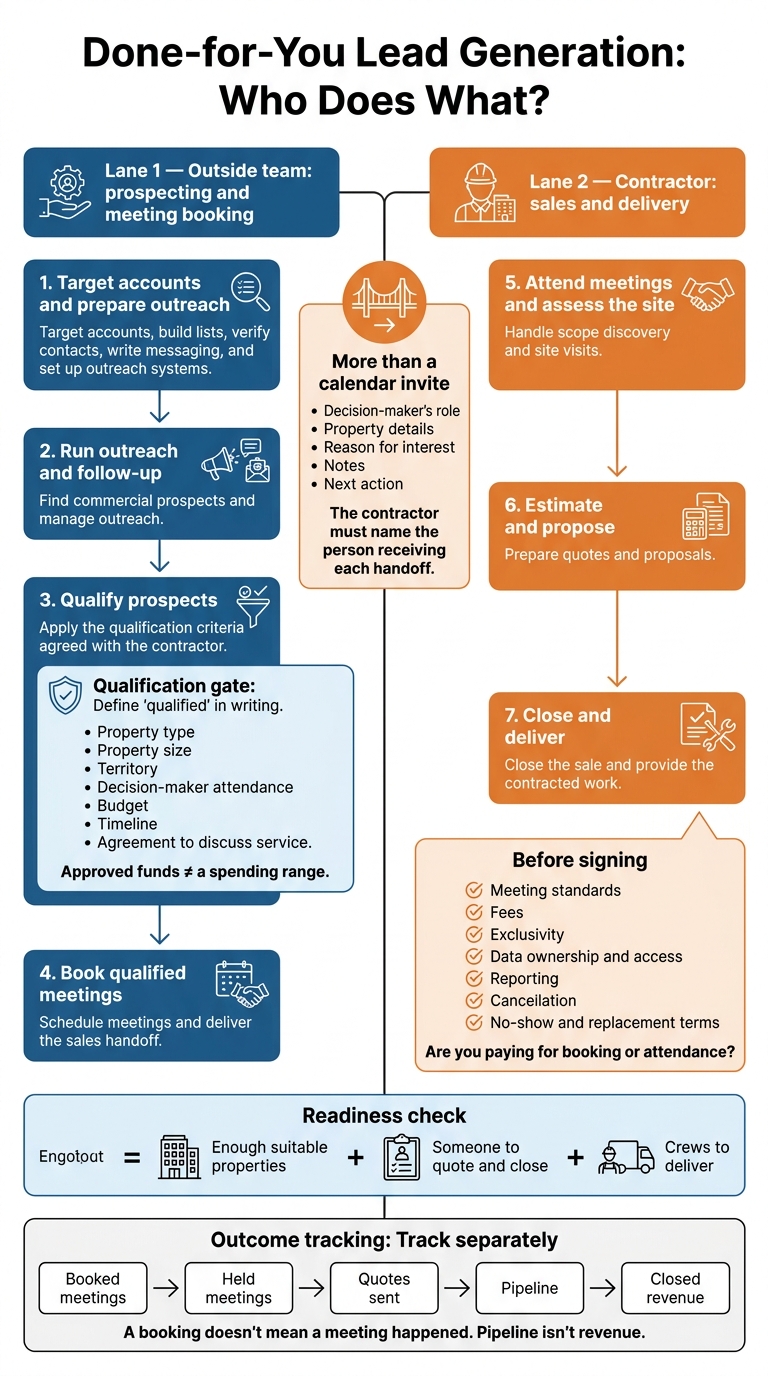
Done-for-You Lead Generation: Who Does What?
How Done-for-You Lead Generation Compares
Compare the work, not the label. Done-for-you prospecting, purchased leads, marketplaces, software, and in-house hiring leave different tasks on your plate. For your commercial contracting business, the key distinction is whether you get qualified meetings or just contact data.
Scope and exclusivity depend on your contract. Owning a contact list, receiving an exclusive inquiry, and holding an exclusive service territory offer different protections.
| Model | What you get | Who qualifies prospects | Exclusivity | Work your team retains |
|---|---|---|---|---|
| Done-for-you lead generation | Managed prospecting and qualified meetings or handoffs | Provider, using agreed criteria | Depends on your contract | Site visits, estimating, closing |
| Purchased leads | Contact records or project data | Your team | May be resold | Research, outreach, qualification, closing |
| Shared-lead marketplaces | Service inquiries | Platform screens; your team qualifies | Shared with competitors | Fast response, qualification, closing |
| Pay-per-meeting services | Scheduled meetings | Provider, using agreed criteria | Set by the contract | Attendance, site assessment, estimating, closing |
| Self-managed software | Data and outreach tools | Your team | Depends on your data | Targeting, messaging, outreach, oversight, sales |
| In-house sales representative | Employee-led prospecting and/or closing | Your rep | Exclusive to your business | Recruiting, training, compensation, tools, management |
Purchased Leads, Shared Inquiries, and Paid Meetings
Purchased contact details give you someone to contact - not proof they’re ready to buy. Shared inquiries can put you up against competitors responding to the same request. The Headline Theory works with one company per service, per service area.
Pay-per-meeting describes how you’re billed, not a guarantee of qualification or attendance. You still need a written qualification standard.
This model can overlap with done-for-you lead generation: a provider may handle research, outreach, qualification, and booking, then charge by the meeting. Before meetings reach your calendar, make sure your contract spells out what makes one qualified.
Software You Run and Sales Reps You Hire
With software or an in-house rep, you still own list quality, messaging, and follow-up. Hiring also means handling recruiting, training, compensation, tools, and management.
Use this lead generation agency versus hiring a sales rep comparison to compare who handles the work - not just what it costs.
Pricing, Meeting Standards, and Timing
Review the fee, meeting requirements, and preparation together. Track booked meetings, held meetings, pipeline, and closed revenue separately. A booking doesn't mean a meeting happened, and pipeline isn't revenue.
Retainers, Per-Meeting Charges, and Setup Fees
| Model | Billing trigger | Included work to check | Contract questions |
|---|---|---|---|
| Monthly retainer | Fixed monthly date | Research, outreach, follow-up, and qualification | Is there a minimum term or 30-day cancellation? |
| Pay per meeting | A qualified meeting is booked or held, as defined in your agreement | Appointment setting and lead screening | Do you pay for no-shows or unqualified meetings? |
| Setup fee | Contract signing | Domain registration, list building, and copywriting | Is the setup fee credited toward the first month? |
| Hybrid | Retainer plus performance minimum | Dedicated caller, buying-signal tracking, and meeting approval | What happens if the minimum is missed? |
Ask directly: Are you paying for booking or attendance? Get cancellation, rescheduling, and no-show terms in writing. Without clear terms, a missed appointment could still count toward your bill or meeting minimum.
A low price doesn't help if you can't use the meetings.
What Makes a Meeting Qualified
Put your qualification requirements in writing. Cover property type, property size, territory, decision-maker attendance, budget, timeline, and agreement to discuss the service. Specify whether “budget” means approved funds or a spending range - they aren't the same. The Headline Theory qualifies every meeting for decision maker, budget, and timeline.
Loose qualification can leave you with bookings that go nowhere. In The Headline Theory's cold email data, one in three replies came from the wrong person, and about 1 in 5 interested replies became a booked meeting (22%; 548 meetings from 2,503 interested replies, Nov 2025 – Nov 2026).
Clear Heating & Air in San Diego previously paid a pay-per-meeting service for five meetings; three had no decision maker present. With The Headline Theory, the contractor closed $40,000 in new commercial jobs and built $150,000 in pipeline.
Your results may vary.
When to Expect Your First Booked Meeting
Before outreach begins, the provider needs to target accounts, build lists, verify contacts, write messaging, and set up outreach systems. Ask which steps need your approval so preparation doesn't stall.
At The Headline Theory, the first booked meeting typically comes about 2 weeks after contract signing. Once outreach is live, things move fast: half of interested replies arrive within 5 hours of the first email, and the median time from a prospect's first email to a booked meeting is 3 days (486 meetings, Nov 2025 – Nov 2026). These are company-specific benchmarks, not an industry average, deadline, or guarantee. They track bookings, not the date the meeting happens or when you close a contract.
Is Your Business Ready to Outsource?
Before you outsource, make sure your sales team and crews can handle more qualified meetings - and the work they may bring. An open calendar isn’t enough. Someone needs to handle scope discovery, site visits, quotes, and closing.
| Your situation | Suitability | Reason |
|---|---|---|
| You’re an established commercial contractor | Strong fit | You already sell to commercial accounts. |
| You have a defined territory and room for more work | Strong fit | Your territory has enough target accounts, and you have capacity for more work. |
| You have an owner or estimator who can quote and close | Strong fit | Someone can turn around quotes and close deals quickly. |
| You serve residential customers only | Poor fit | You sell only to homeowners. |
| You lack sales or fulfillment capacity | Poor fit | You can’t respond, bid, or staff more work. |
| You expect instant inbound inquiries | Poor fit | You need immediate results. |
Count suitable properties in your service area, not just the miles you cover. Ask for a sample prospect list that matches your actual service area, then check whether it includes enough suitable properties. Use property types, sales, permits, and lease activity to estimate the market’s size.
The value of the work matters just as much. One high-value contract can justify outbound outreach. Recurring maintenance agreements and other high-value commercial contracts are a better fit than low-value, one-off jobs.
Before outreach starts, list the accounts you’d turn down, exclude existing customers, and gather references from comparable commercial projects.
What to Check Before Signing
If the fit is right, the contract determines how much control you keep.
Check Qualification, Exclusivity, and Contract Terms
Put your meeting standards in writing: decision-maker, budget, service need, property fit, and timeline. Define when a meeting counts, whether it needs your approval, and when you’re owed a replacement or credit. Confirm territory exclusivity and contact resale rights. Set clear rules for existing accounts and duplicate contacts.
Review setup fees, minimum terms, and cancellation rights. Spell out who owns prospect data, who can export it, how long it’s kept, and when it’s deleted after cancellation. Cover ownership and post-cancellation access for conversation history, domains, and mailboxes, too. Specify how opt-out and do-not-contact records will be kept to prevent future outreach.
With those terms in place, reporting helps you hold the provider accountable.
Set Reporting and Sales Handoff Responsibilities
Require reports on meetings booked and held, accounts contacted, replies, qualification outcomes, and next steps. A handoff should be more than a calendar invite. It should include the decision-maker’s role, property details, reason for interest, notes, and next action.
Assign responsibility for email and calling compliance, deliverability, campaign setup details, calendar availability, CRM updates, and follow-up. Name the person on your team who receives each handoff. Track meetings held, quotes sent, pipeline, and closed jobs. Share those outcomes with your provider so targeting improves based on business results - not appointment volume alone.
Conclusion: Outsource Prospecting, Own the Close
Sign only if the agreement protects your qualification standards, exclusivity, data access, and reporting - and clearly states costs and exit terms.
FAQs
How can you calculate your break-even cost per meeting?
Your break-even cost per meeting is the most you can spend on a qualified meeting without losing money. Here’s the formula:
Average profit per closed contract × Meeting-to-customer close rate = Break-even cost per meeting
You still handle the site walk, quote, and close, so use your own profit and close-rate figures.
Can outreach align with your seasonal sales cycle?
Yes. Your done-for-you provider can adjust targeting and outreach intensity to fit your seasonal sales cycle. Campaigns can focus on seasonal maintenance agreements, equipment replacements, or building types that become active during certain months.
As your capacity and commercial priorities change, you can ask your provider to update the target list so meetings stay aligned with your current needs.
How can you protect your reputation during cold outreach?
Keep cold email campaigns separate from your primary business domain. Reputable providers register and monitor dedicated sending infrastructure to help protect your main domain’s reputation.
Write in plain, conversational language, and skip aggressive sales jargon. Focus on specific buildings, permit triggers, or property events instead of generic email blasts. That keeps your outreach relevant and professional.
Related posts
One company per service area. See if yours is still open.