Best Lead Generation Companies for Commercial Contractors
· 11 min read

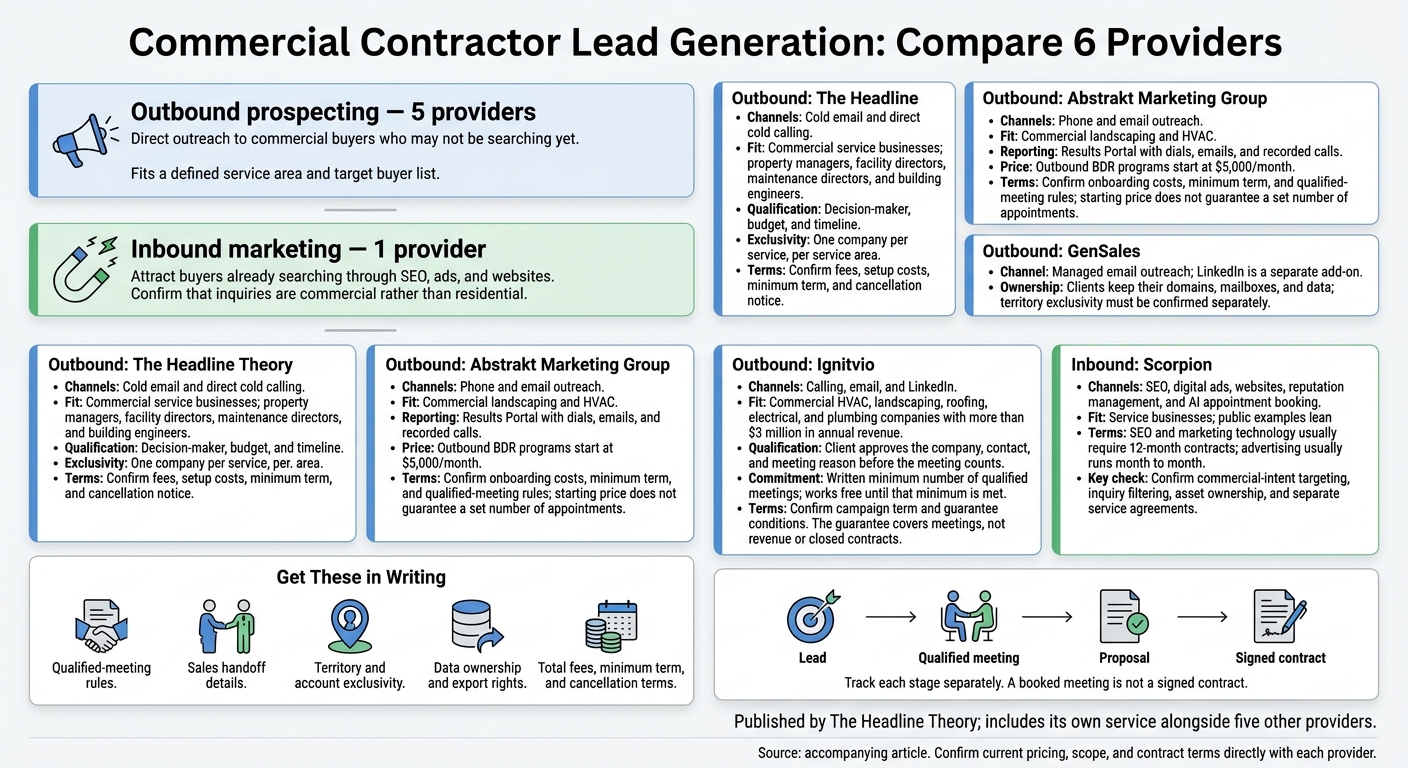
Choose outbound outreach to reach commercial buyers directly - or inbound marketing to reach buyers already searching. Five providers below offer outbound services; Scorpion focuses on inbound. Compare buyer fit, meeting qualification, sales handoff, exclusivity, data ownership, and contract terms - not just monthly fees.
Published by The Headline Theory, this comparison includes its own service alongside five other providers.
Quick Comparison
| Company | Main approach | Best fit | Pricing or terms |
|---|---|---|---|
| The Headline Theory | Cold email and direct calling; checks decision-maker, budget, and timeline | Commercial service businesses seeking buyer meetings | One company per service, per service area; confirm fees and minimum term |
| Abstrakt Marketing Group | Phone and email outreach; reporting portal | Commercial landscaping and HVAC | Outbound BDR programs start at $5,000/month |
| GenSales | Cold calling by U.S.-based SDRs | Phone-led commercial HVAC outreach | Programs usually launch in about 14 days; confirm pricing and term |
| Ignitvio | Calling, email, and LinkedIn; client-approved meetings | Commercial trades with more than $3 million in annual revenue | Written meeting minimum; works free until that minimum is met |
| LeadHaste | Managed email outreach; also offers LinkedIn outreach | General B2B businesses with deals worth $2,000+ | Three-month initial term, then month to month; confirm current fees |
| Scorpion | SEO, ads, websites, and AI appointment booking | Inbound inquiries; public examples lean residential | SEO and marketing technology typically require 12 months; advertising is typically month-to-month |
Before signing, get the qualified-meeting rules, handoff details, territory protection, data export rights, and cancellation terms in writing. A booked meeting is not a signed contract.
1. The Headline Theory
Commercial buyer and channel fit
The Headline Theory provides commercial lead generation and appointment setting for commercial service businesses that want to outsource prospecting and qualification. Its SDR team uses cold email and direct cold calling to reach property managers, facility directors, maintenance directors, and building engineers - not SEO, paid ads, or shared leads. For trade-specific comparisons, see commercial landscaping lead generation companies and commercial HVAC lead generation companies.
Meeting qualification and handoff
Its commercial appointment setting process checks every meeting for decision maker, budget, and timeline, then sends those details to your sales team. The company reports 500+ commercial meetings booked and $10M+ in pipeline for 50+ commercial service companies.
Client example: Mighty Oak Landscaping in Suwanee, GA, received 14 appointments in 10 weeks and closed 7 for $200,000 in annual recurring revenue.
That result is an example, not a guarantee.
Exclusivity and data ownership
The model allows one company per service, per service area. Confirm the exact service category and geographic boundaries in your agreement. Also ask who owns the contact records, campaign data, call notes, and meeting history if you stop working together.
Pricing and contract commitments
Before signing, get pricing, setup requirements, campaign scope, minimum commitment, and cancellation terms in writing. A booked meeting is not a signed contract; weigh the commitment against qualified meetings, not promised revenue.
2. Abstrakt Marketing Group
Commercial buyer and channel fit
Abstrakt Marketing Group serves contractors looking to outsource outbound prospecting and appointment setting. It offers dedicated lead generation services for commercial landscaping and HVAC companies. Before launch, define your service area, target buyer roles, and how many meetings your team can handle.
Meeting qualification and handoff
Check the Results Portal and meeting criteria to assess handoff quality. The portal shows dials, emails, and recorded calls. Set a clear definition of a qualified meeting based on company fit, decision-maker role, service need, and timing. Also ask which prospect details and meeting notes your sales team will receive.
Exclusivity and data ownership
Ask whether territory exclusivity covers geography, service category, and target accounts. Get written terms covering ownership and export of prospect lists, recordings, and meeting history. Portal access alone does not establish ownership after the engagement ends.
Pricing and contract commitments
Abstrakt lists outbound BDR programs starting at $5,000 per month. That price does not guarantee a set number of appointments. Before comparing proposals, request details on included outreach channels, onboarding costs, appointment expectations, minimum term, renewal rules, and cancellation notice.
3. GenSales
Commercial buyer and channel fit
For a phone-first outbound model, GenSales is another option to compare. It offers outbound appointment setting through U.S.-based SDR cold calling and lists commercial HVAC as a focus industry.
GenSales says it has set more than 900,000 B2B appointments since 2002.
Meeting qualification and handoff
Before launch, make sure the meeting criteria and handoff match your sales process. Define your services, territory, account types, job size, decision-maker titles, disqualifying conditions, and appointment format.
Ask how GenSales targets property managers, facility directors, maintenance directors, and building engineers. Also confirm how it handles qualification, scheduling, and CRM handoff.
Once calling starts, review meeting attendance and sales feedback. Request targeting changes when meetings miss the mark.
Exclusivity and data ownership
Ask whether GenSales can contact the same account for another contractor during your campaign. Put data ownership terms in the agreement, including which contact records, call notes, recordings, CRM entries, and campaign data you can keep and export after the engagement ends.
Pricing and contract commitments
GenSales says new client programs usually launch in about 14 days. Get pricing, setup charges, minimum term, cancellation rules, calling volume, reporting access, and the appointment-replacement policy in writing. The agreement should also spell out who handles list development and follow-up.
4. Ignitvio
Compared with GenSales’ phone-first model, Ignitvio adds email, LinkedIn, and a written minimum for qualified meetings.
Commercial buyer and channel fit
Ignitvio handles outbound appointment setting for commercial HVAC, landscaping, roofing, electrical, and plumbing companies with more than $3 million in annual revenue. Its outreach combines a dedicated human caller, cold email, and LinkedIn.
Meeting qualification and handoff
Ignitvio sets meeting criteria before launch: the right title, company size and territory, and a buyer who agreed to talk. You approve each meeting before it counts toward the minimum.
Exclusivity and data ownership
Before signing, ask whether meetings or target accounts are exclusive - and whether competing contractors can approach the same prospects in your service area. Also confirm who owns the prospect records, campaign data, email accounts, and call records when the engagement ends.
Pricing and contract commitments
Ignitvio guarantees a written minimum number of qualified meetings and works for free until it meets that minimum. The guarantee covers meetings, not revenue or closed contracts. Before signing, confirm the minimum, campaign term, approval requirements, and any conditions that pause or extend the guarantee.
5. LeadHaste
Commercial buyer and channel fit
LeadHaste is the next option to compare if you prefer email-first outbound over a phone-heavy approach. It also offers LinkedIn outreach, and the service fits businesses with deals worth $2,000 or more. Commercial trades aren’t a listed specialty, so ask for campaign examples targeting property managers, facility directors, maintenance directors, and building engineers.
Meeting qualification and handoff
Put your qualified-meeting criteria in writing: service area, buying role, service need, and budget. Confirm which details your team receives about prospect fit and intent, how that information reaches your CRM, and how LeadHaste handles no-shows and cancellations.
Exclusivity and data ownership
LeadHaste’s outbound setup uses 20+ sending domains and 40+ warmed mailboxes. Clients keep their domains, mailboxes, and data. Ask which assets your program includes and how they transfer when the engagement ends. Owning domains and data doesn’t give you territory exclusivity - confirm whether competing contractors can target the same accounts.
Pricing and contract commitments
LeadHaste says engagements run on a three-month initial term, then month to month. Get the current monthly and setup fees in writing, confirm whether LinkedIn outreach is priced separately, and check which data you keep when the engagement ends.
6. Scorpion
Commercial buyer and channel fit
Scorpion takes a different approach from the other options in this list: inbound inquiries rather than outbound prospecting.
Scorpion provides inbound marketing for service businesses through SEO, digital ads, websites, reputation management, and an AI assistant. Its public examples lean toward residential work. Ask how it separates commercial-intent searches from homeowner inquiries - lead filtering is the main concern.
Meeting qualification and handoff
Scorpion Convert, its AI assistant, answers calls and responds to missed calls, texts, website chats, Facebook messages, Local Services Ads leads, and contact forms. Scorpion says it qualifies inquiries and, where supported, books appointments directly.
Before launch, confirm which questions it asks, what data it collects, how appointments reach your calendar or CRM, and when a human steps in.
Exclusivity and data ownership
Ask whether you can still access and export leads, call logs, forms, chats, appointments, website content, ad accounts, analytics, and customer lists if you leave.
Also confirm whether competing contractors target the same commercial search terms or geographies. Check whether the website platform, AI tools, or integrations could make moving to another provider harder.
Pricing and contract commitments
Pricing depends on the services you choose. SEO and marketing technology usually require 12-month contracts, while advertising usually runs month to month.
Ask whether the website, reputation management, AI assistant, SEO, and advertising each have separate agreements. Confirm the renewal and cancellation terms for each.
Compare Buyer Fit, Qualification, and Sales Handoff
Compare who each provider targets, how meetings qualify, and what gets passed to your sales team.
| Company | Buyer fit | Qualification rule | Sales handoff |
|---|---|---|---|
| The Headline Theory | Commercial service companies; property managers, facility directors, maintenance directors, and building engineers | Decision-maker, budget, and timeline | Ask which notes come with each appointment |
| Abstrakt Marketing Group | Commercial landscaping and HVAC | Ask about company, contact, and timing requirements | Results Portal with dials, emails, and recorded calls |
| GenSales | Commercial HVAC | Ask how it checks decision-maker status, need, budget, and timing | Ask which notes or recordings your sales team receives |
| Ignitvio | Commercial trades with more than $3 million in annual revenue | Guarantees a minimum number of qualified meetings - not revenue | You approve each meeting before it counts |
| LeadHaste | Broad B2B; deal sizes of $2,000 or more | Ask about the right role, an acknowledged problem, genuine interest, and a confirmed meeting | Ask which prospect details your sales team receives |
| Scorpion | Service businesses; mostly residential examples | Ask how intake separates commercial and residential inquiries | Ask which buyer, property, and service details come with appointments |
Next, compare exclusivity, data ownership, and contract terms.
Compare Exclusivity, Data Ownership, and Contract Terms
Once you’ve confirmed fit, check who controls the territory, data, and contract terms. These details shape who controls the campaign after launch - and whether your team can keep using commercial buyer records and follow-up history when it ends.
| Company | Exclusivity | Data ownership | Pricing or minimum term | Why it matters | Key check |
|---|---|---|---|---|---|
| The Headline Theory | One company per service, per service area. | Confirm who owns prospect records, domains, mailboxes, recordings, and conversation history. | Confirm fees, setup costs, minimum term, and cancellation notice. | Service-area protection for your trade. | Put service and geographic boundaries in writing. |
| Abstrakt Marketing Group | Confirm whether territory exclusivity covers your trade and geography. | Confirm who owns prospect data, recordings, and campaign assets after cancellation. | Outbound BDR programs start at $5,000 per month; confirm total costs and minimum term. | Dedicated commercial landscaping and HVAC services. | Check whether protection covers every market you serve. |
| GenSales | Check whether it serves competing contractors in your area. | Confirm ownership and export rights for contact records, recordings, and conversation history. | Confirm setup fees, monthly charges, minimum term, and renewal rules. | U.S.-based SDRs handle outbound calling. | Check whether protection covers your territory, account list, or neither. |
| Ignitvio | Confirm whether protection applies to your trade, territory, or account list. | Confirm who keeps outreach history, recordings, and approved-meeting records. | Guarantees a minimum number of qualified meetings, but not revenue. | You approve each meeting. | For companies with more than $3 million in annual revenue. Confirm the meeting minimum and cancellation terms. |
| LeadHaste | Check whether competitors can run campaigns in your service area. | Clients keep their domains, mailboxes, and data. | Confirm setup costs, monthly fees, minimum term, and access after cancellation. | You retain outbound assets. | Commercial trades are not a listed specialty. |
| Scorpion | Check whether it works with competing contractors locally. | Confirm who owns the website, ad accounts, leads, and conversation history. | SEO and marketing tech usually require 12-month contracts; advertising is usually month to month. | Advertising typically has a different commitment from SEO and technology. | Most examples are residential; confirm how campaigns will target commercial buyers. |
Before signing, ask for an exit-and-export clause that covers prospect data, domains, mailboxes, recordings, and conversation history. Spell out the export format, access deadline, and transfer fees. For email campaigns, make sure you receive account credentials, DNS control, replies, and suppression lists - not just a contact spreadsheet.
Next, compare outbound and inbound based on what each delivers: a booked meeting is not a signed contract.
Choose Outbound Prospecting or Inbound Marketing
Choose the channel before the provider. For direct outreach to commercial property managers and facility directors, compare The Headline Theory, Abstrakt Marketing Group, GenSales, Ignitvio, and LeadHaste. Outbound fits when you have a defined service area and want to reach buyers who aren’t searching yet.
For inbound marketing, choose Scorpion if your priority is reaching people already searching online through SEO, ads, websites, reputation management, and appointment booking. Its examples are mostly residential, so ask how your campaign would attract commercial accounts - not homeowner inquiries.
Before committing, agree on what counts as a qualified meeting: service need, territory, buying authority, budget or procurement path, and timeline. Require handoff notes that cover the company or property, attendee role, decision-making details, approval process, next step, reminders, no-shows, rejected meetings, and follow-up.
Compare total fees and minimum terms, along with territory exclusivity and ownership of campaign assets and data. Don’t judge providers on monthly price alone.
Track each stage separately: lead, qualified meeting, proposal, and signed contract. Your team still handles estimating, negotiation, and closing. A booked meeting is a sales opportunity - not a signed contract.
FAQs
How do I calculate my lead generation ROI?
Use signed work, not meetings or pipeline: ROI = (gross profit from signed contracts − total program cost) ÷ total program cost. Include the provider's fees, setup costs and your team's time on meetings and proposals, and use the same period for every provider you compare. For recurring contracts, count the contract's annual value, not just the first invoice.
How soon should I expect commercial contracts?
Meetings can start quickly; across The Headline Theory's campaigns, the median time from the first email to the first booked meeting is 3 days. Signed contracts depend on each buyer's review and renewal cycle, so they usually take longer. Mighty Oak Landscaping, for example, got 14 appointments in 10 weeks and closed 7 for $200,000 in annual recurring revenue. Judge a provider on qualified meetings first, then on signed work over a full sales cycle.
Is my sales team ready for outsourced leads?
Before outsourcing leads, agree on what counts as a qualified meeting with your sales team and provider. That means setting clear criteria for the decision-maker, budget, and timeline.
Ask about territory exclusivity, the minimum contract term, and who owns the data. Make sure someone on your team can attend meetings and send proposals promptly.
Related posts
One company per service area. See if yours is still open.