How Do HVAC Companies Get More Commercial Customers?
· 10 min read
HVAC companies get more commercial customers by reaching the right buyers before equipment fails - not just waiting for service calls. Start with properties the crew can serve, contact the people who approve HVAC work, and ask about vendor requirements and contract renewal dates.
This article is published by The Headline Theory. In its HVAC cold email campaigns, about 1 in 4 interested replies became a booked meeting (25%; 108 meetings, Apr – Nov 2026). But replies and meetings alone don't pay the bills. The path to signed work is to:
- Combine email and phone outreach with referrals and Google search.
- Treat marketplace leads as shared bids and confirm who can approve the work.
- Join approved vendor lists before urgent repairs arise.
- Use documented repair findings to propose service agreements.
- Track attended buyer meetings, signed contracts, and acquisition cost - not just inquiries or quoted pipeline.
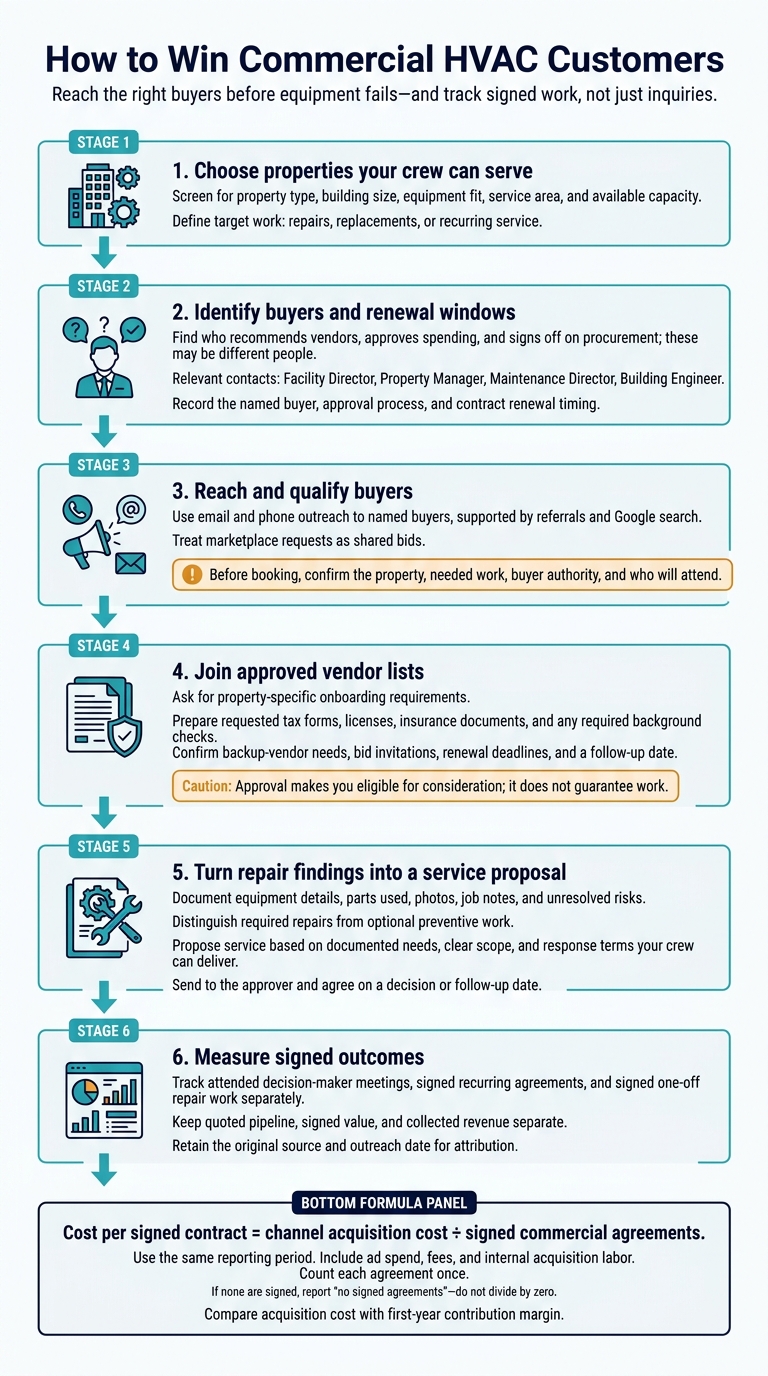
How to Win Commercial HVAC Customers
Choose Your Buyers and Target Properties
Find Out Who Selects HVAC Vendors
Start with the people who control access to the bid. Find out who recommends vendors, who approves spending, and who signs off on procurement. These may be different people.
| Buyer | Buying role | Information you should provide |
|---|---|---|
| Facility director | May approve budgets and vendor selection | Long-term ROI, energy costs, compliance documentation |
| Property manager | Recommends vendors and coordinates purchasing | Response commitments, tenant impact, clear billing and warranties |
| Maintenance director | Recommends contractors based on service needs | Equipment expertise, parts availability, emergency support |
| Building engineer | Recommends contractors based on technical fit | Technical scope, equipment compatibility, repair-versus-replace findings |
Before you bid, ask who’s on the approved vendor list, who gets called first, and when the current agreement renews. That timeline gives you a chance to qualify as a backup vendor before the contract ends.
Keep repair, replacement, and service proposals separate. Buyers should be able to compare scope, exclusions, response commitments, documentation, and warranties without digging. Give your technical contact enough detail to recommend you and the budget approver a clear basis for authorizing the work.
Match Property Types to Your Capabilities
Restaurants and food service are a good place to start if the work fits your team. They produced the most booked meetings in The Headline Theory's HVAC cold email campaigns: 36 meetings, from 26% of their interested replies (Apr – Nov 2026). Set your priorities based on equipment skills, service area, and available capacity.
| Property type | Likely buyer | Main HVAC concerns | Purchasing considerations | Reason to target |
|---|---|---|---|---|
| Hospitality and food service | Facility manager or owner | Downtime, ventilation, refrigeration where applicable | Response speed and relevant repair experience | A good starting point if your team handles urgent service well |
| Multifamily | Property manager or maintenance director | Tenant comfort and unit access | Service costs and coordinated replacements | Multiple units can create recurring service needs |
| Offices | Facility director or building engineer | Air quality and energy costs | Documentation, warranties, scheduled work | Maintenance and planned replacement opportunities |
| Healthcare | Facility director or maintenance director | Critical climate control, filtration, compliance | Specialized skills and service requirements | A fit when your team can meet the technical demands |
| Retail | Property manager, store manager, or owner | Customer comfort and rooftop unit reliability | Clear costs and minimal disruption | An option when nearby locations match your equipment skills |
Build your account list around property type, building size, equipment fit, and target work - repairs, replacements, or recurring service. Record each property’s address, named buyer, approval process, and known renewal timing.
Before prospecting, remove buildings outside your service area or capacity. A contact is only worth pursuing if your team can serve the property.
With your buyers and properties identified, compare the channels that reach them fastest.
Compare Ways to Find Commercial Customers
Use outbound email and calls to reach specific commercial buyers. Use referrals and Google to connect with buyers who have an active need.
| Channel | Buyer intent | Targeting control | Exclusivity | Response speed | What you must verify |
|---|---|---|---|---|---|
| Outbound outreach | Usually no stated need | High: you choose accounts | Non-exclusive | Email takes follow-up; calls connect when answered | Buyer authority and need |
| General contractor referrals | Often project-driven | Low | May be exclusive | Variable | Project scope and authority |
| Property manager referrals | Varies | Low | May be exclusive | Variable | Property needs and authority |
| Google search | Actively researching | Medium | Non-exclusive | Respond promptly | Commercial fit and scope |
| Google Ads | Actively searching | Medium | Non-exclusive | Respond promptly | Commercial fit and scope |
| Angi | Active service request | Limited | Up to four pros | Respond promptly | Commercial fit, authority, scope |
| Thumbtack | Active quote request | Limited | Up to five pros | Respond promptly | Commercial fit, authority, scope |
Start with the named buyers and renewal windows you’ve already mapped.
Contact Named Buyers by Email and Phone
Ask to qualify as a vendor, rather than pushing for an immediate quote request. Follow up, honor opt-outs, and follow email and calling rules.
For the outreach approach, see commercial HVAC lead generation.
In The Headline Theory's cold email data, emails that reached the decision maker's own inbox got 1.8× as many interested replies as emails to someone else at the same business, and the gap held in every trade (775,000+ contacts, Nov 2025 – Nov 2026). Its HVAC campaigns produced one interested reply per 350 commercial property contacts, and 25% of those replies became booked meetings (190,000+ contacts, 108 meetings, Apr – Nov 2026).
Timing matters too: HVAC response doubled in October, ahead of heating season. 1 in 170 contacts replied interested, against 1 in 340 or worse from May to September (35,000+ contacts, 2026). On the phone, HVAC calls reached a live person on 24% of dials (n = 586 dials, October 9–November 19, 2026), and half of live conversations reached a gatekeeper rather than the decision maker (n = 694 conversations).
Build Referrals and Reach Buyers on Google
Give general contractors and property managers clear service details they can share when introducing you. Build trust through those relationships, but don’t count on steady work.
For Google, use commercial-focused pages, accurate service details, and fast follow-up. Set ad budget controls and track which inquiries turn into qualified opportunities. Search reaches buyers with existing demand, but it may miss those who are happy with their current contractor.
Check Marketplace Leads and Meeting Quality
Treat marketplace requests as shared bids, and qualify the decision maker before booking a visit.
Confirm who will attend, which property needs service, what work is needed, and who can approve it. Use the same checks for referrals and booked meetings. Before paying for a meeting, define what makes it qualified.
Keep pipeline separate from closed revenue: an opportunity’s estimated value is not a completed sale.
Northstar HVAC/R built $100,000 in pipeline in one month. Clear Heating & Air in San Diego closed $40,000 in new commercial jobs and built $150,000 in pipeline after paying for five meetings, three without a decision maker. These are company-reported results, not a forecast.
Get on Vendor Lists Before Equipment Fails
Get approved before an emergency repair leaves you in a weak position. Use the renewal window you’ve already mapped to finish vendor onboarding before the next urgent call. Approval makes you eligible for consideration; it does not guarantee work.
Prepare Your Vendor Documents
Ask your onboarding contact for the vendor requirements. These may include background checks, tax forms such as a W-9, and license or insurance documents. Requirements vary, so don’t assume your usual packet will pass review.
Keep your state licenses and insurance certificates current. Make it easy for buyers to check your license through the state registry. If a buyer asks for job notes or photos, send them promptly.
With your packet ready, confirm how the backup-vendor process works.
Ask About Renewals and Backup Vendor Needs
Ask how to join the approved list, how bid invitations go out, and whether the property uses backup vendors. Be clear about the work you handle: emergency repairs, planned maintenance, replacements, and upgrades.
Offer a short qualification call or site walkthrough to learn about the property’s equipment needs and next bid cycle or renewal. Then record the next deadline, the buyer who controls it, and your follow-up date.
Turn Your First Repair Into a Service Agreement
Once you’re approved or invited in, use the first repair to show you’re reliable - and open the door to recurring service. At the closeout review, base your offer on documented needs, not a generic maintenance discount.
Document the Repair and Needs
Save equipment details, parts used, photos, and job notes in your service system. Keep service history and customer communications in your CRM.
During the closeout review, distinguish required repairs from optional preventive work. Explain any unresolved issues, then record the risks and your recommendations.
Base Your Service Proposal on Property Needs
Build your proposal around those risks and recommendations, the property’s equipment, its uptime needs, and its current coverage. Define the scope clearly, and offer response terms your team can deliver.
Send the proposal to the person who can approve it: the facility director, property manager, maintenance director, or building engineer. Confirm whether anyone else needs to review it. Before the conversation ends, agree on a decision, follow-up date, or site visit.
Keep the contract mechanics brief; see how to win commercial HVAC maintenance contracts.
Track Meetings, Signed Agreements, and Acquisition Cost
After the first repair, track which channel led to the meeting and which led to the signed agreement. Focus on attended decision-maker meetings, signed agreements, and acquisition cost, not just inquiries. Keep quoted pipeline, signed value, and collected revenue separate.
Record Decision-Maker Meetings and Signed Agreements
Track three distinct outcomes in your CRM: attended decision-maker meetings, signed recurring agreements, and signed one-off repair work. For each opportunity, record the property type, buyer role, source, scope, and contract value. Link any work won after an initial repair to the original opportunity, but report recurring agreements separately from one-off jobs.
Interested replies and gatekeeper conversations can help you assess your outreach, but they aren’t results. Count a decision-maker meeting only when the relevant buyer attends. Record why opportunities stall or drop out, too, whether that’s budget timing, no response coverage, or poor qualification.
Calculate Cost per Signed Contract
Cost per signed contract = channel acquisition cost ÷ signed commercial agreements. Use the same reporting period for both figures. Include ad spend, fees, and internal acquisition labor, logging time spent on research, qualification, outreach, and surveys so those labor costs don’t get left out.
Keep the original source and outreach date attached to each agreement to account for the gap between first contact and signing. Count each agreement once. If none are signed, report no signed agreements rather than dividing by zero.
Use the same definitions for spend, attended decision-maker meetings, and signed agreements across all channels. Compare acquisition cost with first-year contribution margin to decide whether a channel is worth using again.
Choose Your Next Steps
Choose one property type your crew can serve well. Then focus on one buyer role with the authority to approve HVAC spending.
Start with email and phone outreach to named buyers, followed by referrals. Use Google to reach buyers who are already searching. Treat Angi and Thumbtack as shared bids - not exclusive leads - and qualify every opportunity.
Before equipment fails, confirm vendor requirements, renewal dates, and whether you’re listed as a backup vendor. After a repair, document the equipment’s condition. Use those findings to propose a service agreement tied to the property’s needs.
Track attended meetings with decision-makers, signed agreements, and cost per signed contract. Shift your budget toward channels that bring in signed work at an acceptable cost.
FAQs
How can you win customers who already have an HVAC contractor?
Winning commercial customers starts with reaching the people who make decisions and showing they can count on you before a crisis hits. Get on approved vendor lists so you’re in the running when contracts renew or problems come up.
Reach out directly to facility directors, property managers, maintenance directors, and building engineers. Offer a free building walkthrough to document their equipment. Then use your first repair to show you’re reliable and start a conversation about a recurring service agreement.
Can you win commercial accounts without 24/7 service?
You don’t need 24/7 service to win commercial HVAC accounts. Build relationships with facility directors, property managers, and building engineers. These buyers usually choose contractors from approved vendor lists or established short lists, weighing reliability, response time, and past performance.
Offer a site walk-through before equipment fails to help get your company on those vendor lists. After you complete the first repair, discuss a recurring maintenance agreement.
How often should you follow up with commercial buyers?
Follow up often enough to stay on commercial buyers' radar, but make every touch relevant. In The Headline Theory's two-email campaigns, 72% of interested replies came from the first email and 28% from the follow-up (3,400+ interested replies, Nov 2025 – Nov 2026), so a short sequence followed by a call usually beats a long string of emails.
After that, follow up around contract renewals, ownership changes or new equipment installs. After a first repair, act promptly to offer a recurring agreement.
Related posts
One company per service area. See if yours is still open.