Cold Email vs Google Ads for Commercial Landscaping
· 9 min read
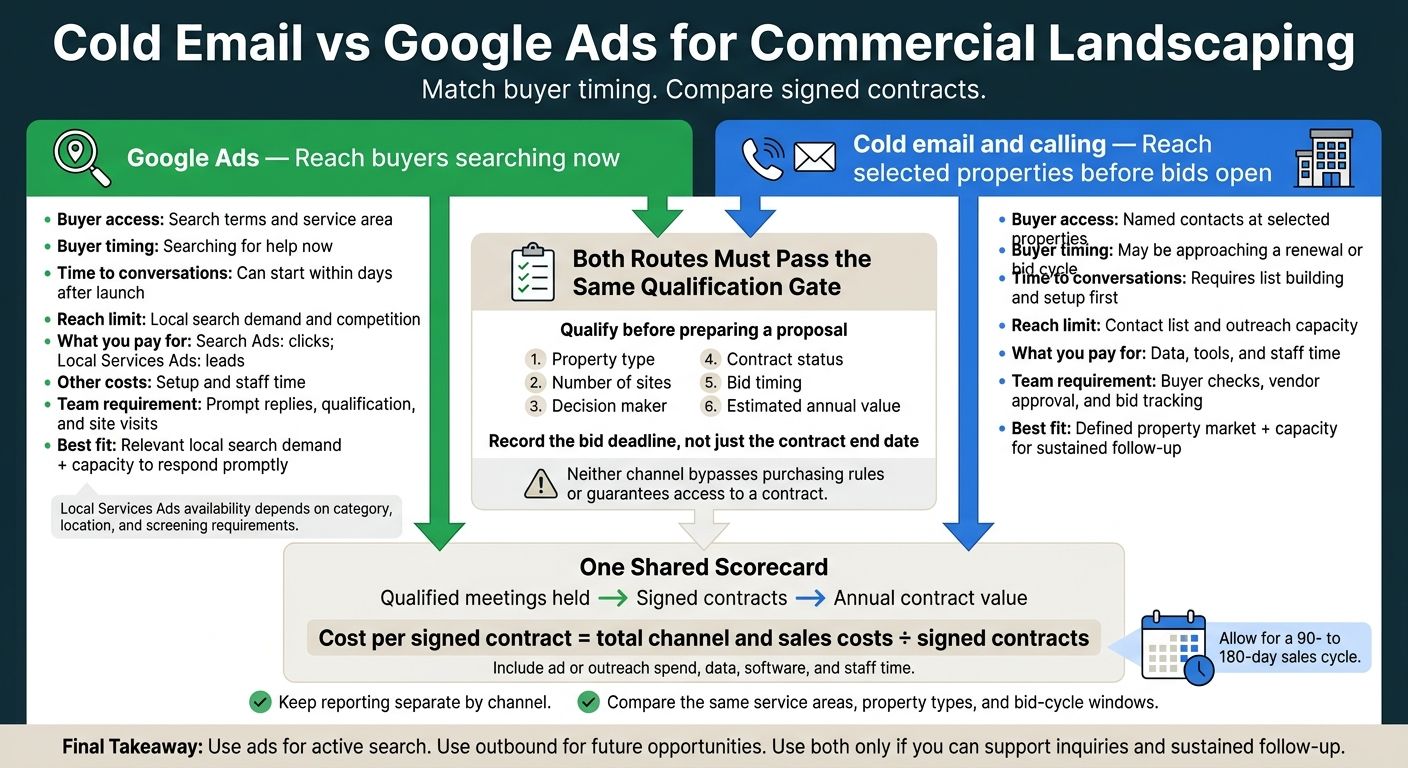
Use Google Ads to reach buyers searching now - and cold email with calling to reach selected properties before bids open. Either way, compare cost per signed contract, not clicks or replies, and give commercial deals time to move through the bid cycle.
The choice comes down to who you want to reach, their contract timing, and your team’s follow-up capacity (or if you should hire lead generation agencies for commercial landscaping). A booked meeting isn’t a signed account. Confirm who selects vendors and record the bid deadline before preparing a proposal.
Quick Comparison
| What to compare | Google Ads | Cold email and calling |
|---|---|---|
| Buyer access | Search terms and service area | Named contacts at selected properties |
| Buyer timing | Searching for help now | May be approaching a renewal or bid cycle |
| Time to conversations | Can start within days after launch | Requires list building and setup first |
| Reach limit | Local search demand and competition | Contact list and outreach capacity |
| Costs | Clicks or leads, setup, and staff time | Data, tools, and staff time |
| Follow-up | Prompt replies, qualification, and site visits | Buyer checks, vendor approval, and bid tracking |
| Success measure | Signed contracts and annual contract value | Signed contracts and annual contract value |
Use the same scorecard for both channels. Track held meetings, contract costs, and annual revenue - and compare buyers at similar stages of the purchasing process.
Google Ads: Reach Buyers Who Are Searching
Target ZIP codes or radii around routes you already service - not every city you could serve. Your reach still depends on local search demand and competing advertisers. Setup matters as much as spend: poor targeting brings inquiries from the wrong properties.
Compare Search Ads and Local Services Ads
| Feature | Google Search Ads | Local Services Ads |
|---|---|---|
| Who it reaches | People researching a service or ready to buy | Local searchers looking for that service now |
| Charging model | Pay per click | Pay per valid lead |
| Lead path | Website or landing page | Direct calls, texts, or emails |
| Eligibility | Available globally for most industries | Limited by category and screening requirements |
| Best use | High-ticket installs and design-build | Recurring maintenance and lower-ticket work |
Google explains Search Ads’ per-click billing and Local Services Ads’ lead billing in its help pages.
Commercial landscaping deals depend on vendor lists, renewals, and bid cycles. That means not every search lead is ready to hire. Once your ads go live, the next task is separating commercial opportunities from other inquiries.
Separate Commercial Leads From Residential Inquiries
Your ads will attract homeowners and commercial buyers, so separate them from the start. Create commercial-only campaigns and landing pages. Use headlines that say commercial landscape maintenance, relevant property photos and references, and details about your insurance coverage. Review search terms weekly and exclude irrelevant searches such as “DIY,” “jobs,” and “mower for sale.”
Ask for the property type, site count, requested services, contract end date, and who selects vendors. An HOA board member gathering bids may be a useful contact without controlling the vendor list. A form submission only matters if it connects you with someone who can influence the contract.
Set Up Tracking and Lead Response
Check service-area settings before launch. For Local Services Ads, use Google’s Local Services Help to confirm current category and location eligibility, along with identity, license, insurance, and screening requirements.
Track calls, forms, GCLIDs, meetings, and signed contracts in your CRM. Tie qualified meetings and signed contracts back to their source. Assign someone to respond within five minutes when possible. When demand exists, conversations can start quickly - but a launch date and budget alone won’t make them happen.
If search volume is thin or responses are slow, outbound outreach may offer a faster way to reach decision makers.
Cold Email and Calling: Reach Your Target Properties
Cold email puts you in touch with property managers, facility directors, building engineers, and other commercial contacts before they start looking for a new landscaper. The first contact may lead to a future bid - not a same-day quote. Commercial landscaping sales depend on contract renewals, vendor lists, and bid cycles.
Find the Buyer and Check Contract Timing
Build your property list using property management directories, public HOA filings, LinkedIn, CoStar, and Reonomy. Then check who chooses the landscaping vendor. An on-site contact doesn’t always have purchasing authority.
Keep your email short. Name the property, explain your service line, and say why you’re reaching out. Ask when the current agreement renews, when bids open, whether there’s an approved vendor list, and who approves the award.
Record the bid deadline, not just the contract end date. That gives you time to follow up before vendor selection starts. If your email reaches the wrong person, a follow-up call can help you find the buyer.
Follow Up With a Call to the Office
A follow-up call to the property can confirm the buyer’s name or clarify how to join the vendor list. Expect gatekeepers. Rather than pushing for a sales meeting, ask who handles landscape maintenance bids.
This article is published by The Headline Theory, which runs cold email and cold calling for commercial landscapers. During its first four weeks of calling, October–November 2026, callers reached a live person on about 26% of 917 dials for landscaping clients. Across all 1,086 dials with a logged outcome, callers reached a live person on 33% of calls to apartment and condo communities, compared with 19% for other commercial property types. These were answered calls - not qualified meetings.
Measure Meetings, Contracts, and Revenue
The Headline Theory reports 1,808 interested replies and 378 booked meetings with commercial decision makers from its landscaping email campaigns. Emails sent to the named decision maker generated about twice as many interested replies per contact. The median time from the first email to the first booked meeting was 3 days.
Mighty Oak Landscaping in Suwanee, Georgia, secured 14 appointments in 10 weeks and closed 7 contracts worth $200,000 in annual recurring revenue, according to The Headline Theory’s commercial landscaping results.
Track qualified meetings, signed contracts, and annual contract value for your campaign. When comparing outbound with Google Ads, use meetings, cost per contract, and annual revenue - not just replies or answered calls.
Cold Email vs Google Ads: Compare Your Options
Compare Reach, Speed, and Costs
Compare access to the buyer, not just inquiry volume. An annual maintenance opportunity only matters if you can reach the buyer before the purchasing deadline. Use this matrix to match each channel to the buyer’s timing.
| Factor | Google Ads (Search + Local Services Ads) | Cold email and calling |
|---|---|---|
| Audience | Homeowners and small businesses | Commercial decision makers |
| Search intent | Buyer is searching now | Buyer is not searching yet |
| First conversation | Days, once live | After list building and setup; The Headline Theory’s median from first email to first meeting is 3 days |
| Reach limit | Local search demand | Target list and outreach capacity |
| Named-buyer targeting | Limited to keywords and geography, not a named buyer | High; you choose the person and property |
| Annual-contract fit | Buyers actively seeking maintenance bids | Properties approaching renewals and bid cycles |
| What you pay for | Search Ads: clicks; Local Services Ads: leads | List building, contact data, tools, and labor |
| What it demands from you | Prompt qualification, site visits, and proposals | Follow-up, buyer identification, and bid tracking |
| Best use | Reaching buyers already searching | Reaching selected properties before they search |
| Main measurement | Qualified meetings and cost per signed contract | Qualified meetings and cost per signed contract |
Google’s help pages explain cost-per-click billing and Local Services Ads lead charges. Measure both channels by qualified meetings, cost per signed contract, and annual contract value.
Match Your Channel to the Buying Situation
The right channel depends on where the buyer is in the purchasing process.
| Buying situation | Google Ads fit | Cold email and calling fit | Your follow-up |
|---|---|---|---|
| Active search | Strong when the buyer searches for your services | Useful if the property is already on your list | Confirm authority, scope, and site-visit availability |
| Upcoming bid cycle | Useful if the buyer searches for bidders | Useful before bids open | Get the bid package and submission deadline |
| Existing vendor contract | Limited if the buyer is not searching | Useful for developing a future opportunity | Confirm whether switching is possible and schedule follow-up |
| Vendor approval | An inquiry does not make you eligible | Outreach can identify the application process | Submit required credentials and confirm approval |
| Urgent service problem | Strong when the buyer searches for immediate help | Useful if you reach the affected property in time | Confirm whether the call concerns emergency work or future maintenance |
| New property acquisition | Useful when the new team searches for vendors | Useful for reaching the new management team | Confirm who controls existing agreements and future awards |
Neither channel bypasses purchasing rules or guarantees access to a contract. A service complaint alone does not open an annual contract. Before spending time on a proposal, confirm whether the buyer needs temporary help, is requesting competitive bids, or is planning a future renewal.
Choose ads when there’s relevant local search demand and you can respond promptly. Choose outbound when you have a defined property market and the capacity for sustained follow-up. Use both if you can handle urgent inquiries while contacting buyers about future renewals.
Use the same qualification fields for both channels: property type, number of sites, decision maker, contract status, bid timing, and estimated annual value. Keep reporting separate so you can track which channel produces qualified meetings, signed contracts, and annual value.
Conclusion: Choose Based on Signed Contracts
After comparing reach, speed, and cost, judge both channels by signed contracts. Use ads to reach people already searching and outbound to contact selected properties that aren’t searching yet. Run both only if you can handle inquiries, site visits, and follow-up.
Before moving budget, compare the same service areas, property types, and bid-cycle windows. Don’t weigh mature ad results against outbound prospects that haven’t reached renewal.
Measure Meetings, Contract Costs, and Annual Revenue
Use the same scorecard for both channels: qualified meetings held, signed contracts, annual contract value, conversion rates, and target-property share. Separate future renewals and bid cycles from opportunities ready to award. Track held walkthroughs, not just booked meetings, because a no-show costs you the same prep time.
Cost per signed contract = total channel and sales costs ÷ signed contracts.
Include ad or outreach spend, data, software, and staff time. Apply the same cost rules to both channels, and allow enough time for deals to move through the bid cycle.
Treat clicks and forms as signs of progress, not reasons to increase spending. Compare annual contract value and track whether each account can generate year-2 referral revenue.
FAQs
How should you split your budget between ads and outreach?
Make cold email your main channel for recurring commercial contracts. You control the target list and can reach property managers who aren’t currently looking for a vendor.
Use Google Ads as a supporting channel to bring in urgent, one-time jobs from buyers already searching. Ads can also help your company show up when prospects search for it by name after reading your emails.
How can you avoid contacting the same prospect through both channels?
Keep prospect lists separate and manage who you target. Use Customer Match lists to exclude active cold outreach contacts from Google Ads targeting.
Overlap can still happen when someone on your outreach list searches for your services. Use negative keywords to help filter out competitor and residential searches. Keep commercial landing pages separate from residential campaigns so you can track and qualify leads separately.
When should you stop a campaign that hasn't won contracts?
Stop a campaign if the cost per signed contract exceeds the value you gain from the work.
Commercial landscaping has long sales cycles. Don’t judge a campaign by early clicks or lead volume alone. Track qualified meetings, bid requests, and final contract value.
Give leads time to move through the bid cycle. If they consistently fail to turn into contracts, adjust your targeting or messaging.
Related posts
One company per service area. See if yours is still open.