How Much Does Appointment Setting Cost for Commercial Contractors?
· 8 min read

One provider lists outbound appointment-setting programs starting at $5,000 per month - but that’s one starting price, not a market average. Compare your total cost per signed contract, including fees and your team’s sales time, rather than the price per meeting alone.
Here’s what to check before signing:
- Payment model: Monthly retainer, pay per appointment, retainer plus bonus, or an in-house SDR. A meeting guarantee can sit within a plan; it isn’t a promise of sales.
- Work included: Calls, emails, property research, screening, follow-ups, setup, and reporting. Territory, exclusivity, and contract length can also affect your quote.
- Meeting rules: Define buyer authority, budget, and timeline - and whether you pay for booked or attended meetings.
- Contract protections: Put no-show replacements, extra charges, cancellation terms, and data ownership in writing.
In the first four weeks of The Headline Theory’s cold calling program (Oct–Nov 2026), its callers dialed 1,280+ commercial properties and booked 15 on-site estimate meetings for landscaping and HVAC clients. Most of that work never turns into a meeting, and the price has to cover it. So judge offers on qualification and signed work - not just a busy calendar.
Appointment-Setting Pricing Models Compared
As a commercial contractor, you’ll usually pay for appointment setting through one of these models.
| Model | What you pay for | Who carries the risk | Best for | Ask this |
|---|---|---|---|---|
| Monthly retainer | Recurring outreach work | You carry the risk of low meeting volume | You need steady outreach | Setup fee? Minimum term? Included services? |
| Pay per appointment | Meetings that meet agreed criteria | The provider carries volume risk; you carry quality and attendance risk unless protected | You want spending tied to meeting delivery | Booked or attended? What earns a replacement? |
| Retainer plus performance bonus | Outreach work plus a bonus for a defined result | Shared: you pay the base, and the provider earns bonuses | You want steady outreach with a results-based incentive | What triggers the bonus? Can one meeting trigger multiple charges? |
| Meeting guarantee | A minimum-meeting commitment attached to your plan | The provider carries the stated delivery obligation; you retain sales risk | You want a written minimum commitment | Deadline? Remedy if the target is missed? |
| In-house SDR | Salary, benefits, data, tools, training, and management | You carry hiring, ramp-up, and turnover risk | You need direct control and have management capacity | What is the full operating cost beyond salary? |
Whichever model you choose, the meetings still need to be qualified and able to turn into sales opportunities.
Monthly Retainers Pay for the Outreach Program
A retainer pays for outreach work - not a guaranteed meeting count, unless your contract says otherwise.
Abstrakt Marketing Group lists outbound BDR programs starting at $5,000 per month on its pricing page.
Treat this as one published starting price, not a general rate. Ask which services are included and whether setup costs are covered.
Per-Meeting Fees and Bonuses Need Clear Payment Rules
With pay-per-appointment pricing, you should pay only for meetings that meet your written qualification rules. A hybrid plan pairs a base retainer with a performance bonus.
Booked and attended are different billing triggers. If the provider bills at booking, you still pay for cancellations or no-shows unless the contract says otherwise.
Spell out how the provider handles meetings with people who lack buying authority: Are they nonbillable, credited, or replaced? For hybrid plans, apply those same rules to bonuses so a calendar entry alone doesn’t earn performance pay.
Meeting Guarantees Do Not Guarantee Revenue
A meeting guarantee can be part of a retainer or another payment structure. It should spell out the minimum number of qualified meetings, delivery window, replacement rules, and remedy if the provider falls short.
Free work or credits address a missed target. They don’t guarantee revenue.
Next, compare what drives the price: the work behind the billing model.
What Drives Your Appointment-Setting Cost
Channels, Data, Territory, and Contract Terms
Your quote should match the work it takes to reach decision makers. Ask for an itemized scope, including the cold-calling work.
| Cost driver | Work your quote should account for |
|---|---|
| Cold calling versus cold email | Calls take caller time and work to get past gatekeepers. Email needs sending infrastructure and deliverability management. Using both adds coordination. |
| Territory | A larger area needs more data sourcing. A small area may need deeper research into a limited pool of properties. |
| List building and data access | Property research, contact verification, and paid data subscriptions. Check what’s included and what costs extra. |
| Attempts and follow-ups | Repeated calls and emails take time, even when they don’t lead to a meeting. |
| Qualification | Confirm who checks property fit, buying authority, budget, and timeline: the provider or your team. |
| Setup fees | Check whether the price includes messaging, scripts, email infrastructure, CRM integration, and launch testing. |
| Minimum terms | Compare the total commitment - not just the monthly charge. A longer agreement puts more of your money at risk. |
| Exclusivity | Define the protected service and territory. This limits which competing accounts the provider can accept. |
| Seasonal or service-specific needs | Seasonal outreach windows may require staffing changes. Specific facility requirements add screening work. |
First-Party Data: 4 Weeks of Commercial Cold Calling
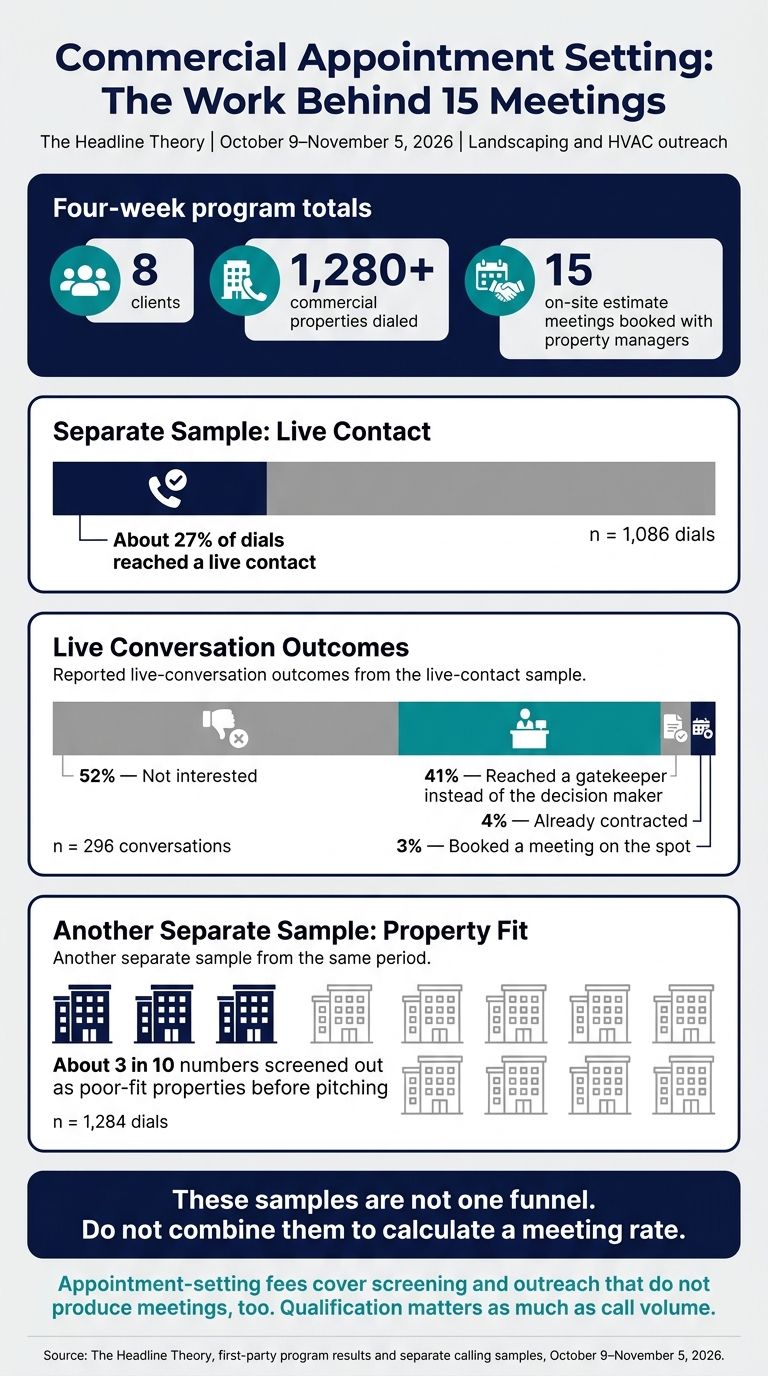
This article is published by The Headline Theory, which runs appointment setting for commercial contractors. From October 9–November 5, 2026, its eight-client landscaping and HVAC program dialed 1,280+ commercial properties and booked 15 on-site estimate meetings with property managers.
Of the dials with a logged outcome, callers reached a live person on about 27% (n = 1,086 dials). Of those live conversations, 52% were not interested, 41% reached a gatekeeper instead of the decision maker, 4% were already contracted, and 3% booked a meeting on the spot (n = 296 conversations).
Callers also screened out about 3 in 10 numbers as poor-fit properties before pitching (n = 1,284 dials).
These figures use slightly different bases, so don’t divide them into a meeting rate. They show why your fee covers screening and outreach that doesn’t produce meetings, too. Qualification rules matter as much as call volume.
What Qualification and Exclusivity Include
Your quote should spell out who handles research, screening, gatekeeper calls, follow-up, scheduling, and confirmation - and what your estimator receives.
The Headline Theory’s SDR team uses cold email and one-to-one cold calls and qualifies every meeting for decision maker, budget, and timeline. Its service-area exclusivity means one company per service per service area. That’s different from appointment exclusivity, which only means a meeting isn’t shared.
Across all campaigns, The Headline Theory reports 500+ commercial meetings and $10M+ in pipeline for 50+ commercial service companies through its appointment-setting service. Pipeline is potential business, not closed revenue. Treat those results as context while checking whether your quote includes the qualification and follow-through your sales process needs.
Compare Your Cost per Signed Contract
Once you know what the fee covers, check what you’re paying for each signed contract.
A low appointment fee can still mean a high cost if the meeting never leads to a proposal or signed job. Your team still spends time on prep, travel, estimating, and follow-up.
The Cost of Meetings Without a Decision Maker
Those hidden costs add up fast when no decision maker attends.
Clear Heating & Air in San Diego paid upfront for five pay-per-meeting appointments; three had no decision maker present. The Headline Theory later helped it close $40,000 in new commercial jobs and build $150,000 in pipeline; that result was one client example, not a guarantee.
Measure the fee against signed work, not meetings that waste your team’s time.
Calculate Your Cost per Signed Contract
Count all costs: program fees, setup fees, and the dollar value of prep, travel, estimating, follow-up, and failed meetings.
Cost per signed contract = (program fees + setup fees + internal sales time) ÷ signed contracts
Convert internal sales time into dollars before adding it to the total.
Compare providers over the same time frame and use the same attribution rules. Allow enough time for jobs to close before judging results. Track meetings held, decision-maker attendance, proposals, and signed contracts. With no signed contracts, you can’t yet calculate a cost per signed contract.
Compare the Full Cost of an In-House SDR
Salary is only part of the cost. Include payroll taxes, benefits, tools, data, management, training, and ramp time.
Compare that total with outsourced fees using the in-house SDR versus agency guide. Apply the same signed-contract formula to both options.
Conclusion: Compare Contract Terms Before Price
Compare quotes using the same outreach scope and the same definition of a qualified, attended meeting. Judge offers by cost per signed contract, not meeting count. A meeting guarantee does not promise signed contracts, so spell out the remedy if the provider misses the target. Use the checklist below to compare offers line by line.
Your Checklist Before Signing
Define what you’re buying. Separate leads, booked meetings, and held meetings. Document requirements for decision-maker attendance, budget, timeline, service need, and facility size and type. Specify which poor-fit properties won’t count toward the total.
Assign attendance risk. State whether you pay for booked slots or held meetings. Address cancellations, no-shows, and meetings that don’t meet your criteria. Include replacement rules, dispute deadlines, and whether you’ll receive a refund, credit, or rebooking.
Check scope and exit terms. Ask for a sample invoice that lists setup, data, platform, and CRM integration charges separately. Document included attempts and follow-ups, the minimum term, renewal rules, cancellation notice, and termination terms. Define exclusivity by both service and service area - not just whether an appointment is shared.
Protect your records and reporting. Specify who owns prospect lists, sending domains, call recordings, and CRM data after termination. Require reporting that links outreach, qualification, attendance, opportunities, and signed contracts so you can compare cost per signed contract across providers.
FAQs
How long should you test an appointment-setting service?
Agree on a fixed test period and written success criteria before you start, and check the service’s minimum contract term so the test doesn’t lock you in longer than planned.
Measure the test by cost per signed contract, not cost per meeting:
(Total fees − credits) ÷ signed contracts attributed to the service
Also, confirm what counts as a qualified meeting, how the service handles no-shows and replacements, and who owns the data.
How can you tell whether appointment setting will be profitable?
Measure profitability by cost per signed contract, not cost per meeting:
Cost per signed contract = total program cost ÷ signed jobs from those appointments.
Include setup fees and the cost of time spent on unqualified meetings.
When comparing retainers, pay-per-appointment pricing, retainer-plus-bonus plans, and meeting guarantees, check qualification standards, no-show terms, and contract length. Guaranteed meetings don’t necessarily mean guaranteed revenue.
Should you pause appointment setting during your off-season?
Before you pause appointment setting for the off-season, check your minimum contract term and what your fees cover. A monthly retainer pays for managed effort, pay-per-appointment pays for booked meetings, and a hybrid combines the two. Meeting guarantees promise qualified meetings - not revenue.
Check the qualification standards, too. Unqualified meetings waste your time. Measure value by cost per signed contract: total program cost ÷ signed contracts.
Related posts
One company per service area. See if yours is still open.