Exclusive Lead Generation Companies for Commercial Service Contractors
· 9 min read

Exclusive leads, protected territories, and booked meetings are not the same thing. Before hiring a provider, get the service area, buyer requirements, data rights, and replacement or refund rules in writing.
This comparison covers The Headline Theory, Ignitvio, Landscape Marketing Pros, and Abstrakt Marketing Group. It also explains how their services differ from shared marketplaces such as Angi and Thumbtack.
Quick Comparison
| Provider | Main service | Exclusivity to check |
|---|---|---|
| The Headline Theory | Cold email and calls to book commercial meetings; confirms decision maker, budget, and timeline | Covered services, territory, and excluded accounts |
| Ignitvio | Outbound appointment setting for contractors with over $3 million in annual revenue; meeting approval and a written minimum | Territory protection is separate from the meeting guarantee |
| Landscape Marketing Pros | SEO, websites, and Google Local Service Ads for landscapers | Service-area protection; inquiry screening needs separate review |
| Abstrakt Marketing Group | B2B lead generation and appointment setting; outbound BDR programs start at $5,000 per month | Written limits on serving competing clients |
This article is published by The Headline Theory and includes its own service.
Unlike exclusive delivery, Angi Market Match requests can reach up to four pros, while Thumbtack customers can receive quotes from up to five pros. But exclusivity alone does not prove a buyer has authority, funding, or a timeline.
The final test is cost per signed contract - not cost per lead. Compare provider fees, campaign costs, follow-up, and proposal time against the contracts won.
What Exclusive Leads, Territories, and Meetings Mean
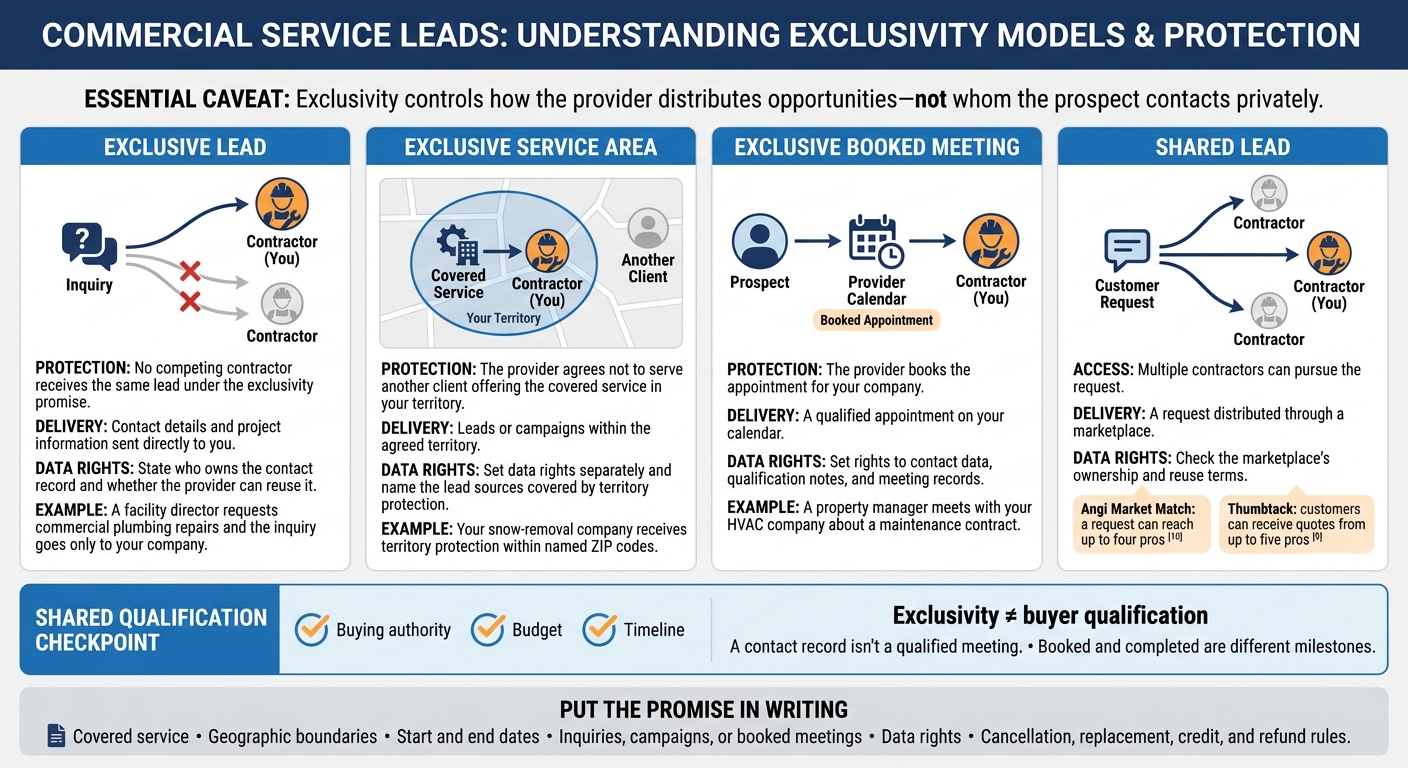
Exclusive Leads vs. Territories vs. Booked Meetings
Exclusive can mean your company alone gets the lead, the territory, or the meeting. It controls how the provider distributes opportunities - not whom the prospect contacts privately. Your agreement should spell out the covered service, geographic boundaries, start and end dates, and whether protection covers inquiries, campaigns, or booked meetings.
| Model | Data rights | Competitor access | Delivery method |
|---|---|---|---|
| Exclusive lead | State who owns the contact record and whether the provider can reuse it. | No competing contractor receives the same lead under the exclusivity promise. | Contact details and project information sent directly to you. |
| Exclusive service area | Set data rights separately and name the lead sources covered by territory protection. | The provider agrees not to serve another client offering the covered service in your territory. | Leads or campaigns within the agreed territory. |
| Exclusive booked meeting | Set rights to contact data, qualification notes, and meeting records. | The provider books the appointment for your company. | A qualified appointment on your calendar. |
| Shared lead | Check the marketplace’s ownership and reuse terms. | Multiple contractors can pursue the request. | A request distributed through a marketplace. |
Exclusive lead: A facility director requests commercial plumbing repairs and the inquiry goes only to your company.
Exclusive service area: Your snow-removal company receives territory protection within named ZIP codes.
Exclusive booked meeting: A property manager meets with your HVAC company about a maintenance contract.
Shared lead: An Angi Market Match request can reach up to four pros; Thumbtack customers can receive quotes from up to five pros.
A contact record isn’t a qualified meeting. Require the prospect’s name, business, contact details, meeting time, service need, location, and calendar confirmation. Also set cancellation, replacement, credit, and refund rules. Booked and completed are different milestones. For more, see The Headline Theory’s appointment-setting page.
Getting a meeting on the calendar isn't enough. The handoff must show that the prospect fits your requirements. In The Headline Theory's cold email data, one in three replies came from the wrong person rather than the decision maker (35,000+ replies, Nov 2025 – Nov 2026). Before proposal work starts, qualification should confirm buying authority, budget, and timeline. Ask who approves the work, whether funding is available or the proposal supports an active budget decision, and when work needs to begin.
A job title alone doesn’t prove purchasing authority. To move toward a signed contract, the meeting needs to reach the decision maker with budget and timeline confirmed.
Put these standards in writing before outreach starts. Specify who must attend and what happens when a meeting falls short, then use those terms to compare the providers below.
1. The Headline Theory
The Headline Theory offers done-for-you commercial lead generation. ]
Our SDR team builds prospect lists, then contacts property managers, facility directors, maintenance directors, and building engineers through personalized cold emails and one-to-one cold calls. Before booking a meeting, we confirm the decision maker, budget, and timeline. Meetings go straight to your calendar; your team handles estimating, quoting, and closing. See the appointment-setting delivery process.
The agreement should spell out the covered services, service-area boundaries, and excluded accounts. Keep current customers and active opportunities off outreach lists.
The Headline Theory's cold email and cold calling have booked 600+ meetings with commercial property decision makers for its clients since November 2025. About 1 in 5 interested email replies became a booked meeting (22%; 548 meetings from 2,503 interested replies, Nov 2025 – Nov 2026). These are company-reported results, not a guarantee.
2. Ignitvio
Ignitvio handles outbound appointment setting for commercial HVAC, landscaping, roofing, electrical, and plumbing companies with annual revenue above $3 million. The service pairs a dedicated caller with cold email and LinkedIn outreach to book qualified meetings on your calendar.
No meeting counts until you approve it. Ignitvio screens meetings against agreed criteria. The company also guarantees a written minimum number of qualified meetings. If it falls short, it keeps working at no charge until it reaches that target.
Get the qualification criteria in writing, including decision-maker title, company size, service fit, territory, and buying trigger. Confirm the approval process, your deadline to approve or reject meetings, and whether cancellation stays free when a meeting fails to meet those requirements.
Ask for written territory terms covering your service line and geographic boundaries, too. Can another contractor be assigned the same area? A qualified-meeting guarantee is not territory protection. That distinction matters most if booked meetings are your first priority and territory protection comes second.
3. Landscape Marketing Pros
Landscape Marketing Pros takes a different approach from outbound appointment setting. It offers SEO, websites, and Google Local Service Ads for landscapers, with service-area exclusivity. These channels help prospects find your business; they don’t book meetings.
Get the territory protection and services in writing. Specify the exact cities, ZIP codes, counties, or radius; covered service lines; included channels; and how long the protection lasts.
Then check how the company screens inquiries before passing them to you. Confirm that screening covers commercial fit, service needs, location, budget, and timeline. Service-area exclusivity alone doesn’t guarantee qualified commercial inquiries.
4. Abstrakt Marketing Group
Abstrakt Marketing Group offers B2B lead generation and appointment setting, with outbound BDR programs starting at $5,000 per month.
Get territory exclusivity in writing before assuming the program is exclusive. Ask whether Abstrakt can market another client to the same prospects, service lines, or ZIP codes. If you need both appointments and territory protection, include both in the agreement.
The agreement should also define a qualified meeting, outreach channels, delivery method, and reporting schedule. Clarify whether any guarantee covers booked, qualified, or attended meetings - and what remedy applies if targets are missed. Use these terms as the basis for comparing Abstrakt with shared marketplaces like Angi and Thumbtack.
Exclusive Services vs. Angi and Thumbtack
Exclusive lead delivery sends an inquiry to one contractor. Exclusive appointment setting books a meeting only for you. Angi and Thumbtack use shared marketplaces, where contractors compete on speed, price, availability, and follow-up.
| What to compare | Exclusive lead delivery | Exclusive appointment setting | Angi Market Match | Thumbtack |
|---|---|---|---|---|
| Exclusivity | One contractor receives the inquiry within agreed service, territory, and time limits. | The meeting is booked only for you within agreed service, territory, and time limits. | Shared request. | Shared quote request. |
| Competitor access | Ask whether competitors can receive the same contact. | Ask whether the provider prevents duplicate outreach in your territory. | A request can reach up to four pros; you’re charged when the lead is sent. | Customers can receive quotes from up to five pros. |
| Qualification and authority | Confirm service fit, budget, timeline, and buying authority. | Confirm service fit, budget, timeline, and the attendee’s buying authority before booking. | Ask who checks service fit, budget, timeline, and buying authority. | Ask who checks commercial service fit, budget, timeline, and buying authority. |
Sending a request to four Angi pros or five Thumbtack pros tells you nothing about the buyer’s authority, budget, or timeline. An exclusive meeting needs those same checks. See our exclusive leads vs. Angi and Thumbtack comparison for more.
The test is whether a lead or meeting turns into a signed commercial contract. Compare cost per signed contract: total acquisition cost ÷ signed contracts. Include follow-up and proposal time in that cost.
Before you sign, get exclusivity, qualification, data ownership, and remedies in writing.
Before You Sign: Contract Terms and Cost per Signed Contract
Once you’ve compared providers, put the deal terms in writing before you sign. Define exactly what exclusivity covers: the service, geography, brand, branch, and contract term. Specify whether it applies to leads, territory, or booked meetings - and what happens if the provider breaks that agreement.
Spell out meeting rules and remedies. Set qualification criteria for role, authority, need, budget, timeline, fit, and location. Clarify whether attendance is required, how cancellations and no-shows count, and who handles rescheduling. Document approval requirements, rejection windows, acceptable rejection reasons, and the evidence needed. Set deadlines for replacements, credits, or refunds when a lead or meeting doesn’t meet the criteria. Require calendar records, notes, email history, and call recordings to help resolve disputes.
Check the exit and data terms. Record the minimum term, renewal rules, notice period, termination rights, and what happens to meetings already booked. To keep attribution intact, specify who owns the data, who can export it, what stays accessible after termination, and whether the provider can reuse it.
Keep provider, source, campaign, service, branch, and territory tags attached to every opportunity throughout the sales cycle, including CRM transfers and exports. Those tags let you measure revenue by source. Match delivery reports against signed agreements so you can trace booked work and signed revenue back to the provider, source, and territory.
Cost per signed contract = total acquisition spend ÷ signed contracts. Include provider fees, campaign costs, and direct sales costs. Use a consistent measurement period that gives your sales cycle time to play out. Apply the same framework across your commercial lead-generation provider comparison: written protection, qualification, remedies, and revenue visibility matter more than cheap leads, while signed contracts measure business you actually win.
FAQs
How can we verify lead exclusivity?
Ask for written definitions of “exclusive” and “qualified meeting.” Spell out the covered services and territory, plus qualification criteria: decision-maker, budget, and timeline. Confirm whether you approve meetings before they count and what happens when a meeting is unqualified or missed.
The Headline Theory defines exclusivity as:
“one company per service, per service area.”
Every meeting is qualified for decision maker, budget and timeline, and logged in its CRM and on the client's tracking sheet.
Should we choose exclusive leads or booked meetings?
Choose territory exclusivity for control in your area. Choose exclusive booked meetings if you want appointments scheduled only for your business.
“Exclusive” can mean leads sold only to you, one company per service and area, or meetings booked only for you. Shared leads, by contrast, go to multiple contractors.
The Headline Theory serves one company per service, per service area and does not sell shared leads.
How long should we test a provider before evaluating results?
Test a provider for at least one full sales cycle. Before signing, get written confirmation of what counts as a qualified meeting, the minimum contract term, and any trial period.
Judge meetings by whether they connect you with decision-makers who match your target profile and sales goals - not just how many leads you get. A booked meeting isn’t a signed contract.
Related posts
One company per service area. See if yours is still open.